
Summary
Editor's rating
Is it worth the money compared to cheap units and top‑end Bushnells?
Compact size, simple controls, one small magnet annoyance
USB‑C rechargeable battery: finally no more random CR2 runs
Light, plastic, and water‑resistant – but don’t abuse it
Accuracy, speed, and Slope: the stuff that actually matters
What you actually get in the box and how it feels in hand
Pros
- Compact and light but still easy to hold steady with 6x magnification
- Fast, consistent yardages with Pinseeker and JOLT that actually locks onto the flag
- USB‑C rechargeable battery with enough life for many rounds and no CR2 hassle
Cons
- Magnet is in a separate sleeve instead of built into the unit
- Plastic build feels more functional than premium
- Not the cheapest option if you only play a few times per season

Specifications
View full product page →| Brand | Bushnell |
A small Bushnell that doesn’t feel like a downgrade
I’ve been using the Bushnell Golf A1‑Slope for a bunch of rounds now, and I’ll be straight: I bought it because I was tired of messing around with cheap Amazon rangefinders that die at the worst possible moment. I also didn’t feel like dropping 600 bucks on the top-end Bushnell when, at the end of the day, I just need the distance to the flag and a slope number. This A1‑Slope sits in that middle ground: serious brand, smaller price, still not exactly cheap.
On the course, I used it side‑by‑side with a buddy’s higher‑end Bushnell and another friend’s random budget rangefinder. I wanted to see if going for the “smaller Bushnell” meant I’d lose accuracy or speed. Short version: the yardages were basically the same as the expensive Bushnell every single time, and it locked on to flags a lot faster than the budget unit. No weird jumps in distance, no guessing if it caught the tree behind the green.
What really pushed me to test this one was the size and the fact it’s USB‑C rechargeable. I’m done with those coin batteries that die mid‑season and cost a small fortune at the pro shop. With this, I charge it like my phone, toss it in the bag, and don’t think about it. Bushnell claims 40 rounds on a charge. I haven’t hit that yet, but I’ve done around 10 full rounds plus range sessions and the battery hasn’t been an issue at all.
So overall, first impression: it’s a compact Bushnell that feels like the real deal, not a stripped‑down toy. It’s not perfect, and I’ll get into that, but if you just want a solid tool to get numbers quickly without overthinking it, this thing does the job very well.
Is it worth the money compared to cheap units and top‑end Bushnells?
On value, this sits in an interesting spot. It’s not the cheapest rangefinder out there, and it’s clearly below Bushnell’s top‑end models in price. For what you pay, you’re getting a reliable brand, slope tech that’s already proven on tour‑level devices, and a compact design with USB‑C charging. If you’re the type who always grabs the lowest‑priced gadget on Amazon, this will feel expensive at first. But once you use it and see how consistent and quick it is compared to the budget stuff, it starts to make sense.
Here’s how I see it in simple terms:
- Versus cheap rangefinders: this is more expensive, but you get faster lock‑on, better accuracy, a brand that actually stands behind the product, and a much better user experience. If you’re tired of guessing whether your rangefinder caught the flag or the background, this is an upgrade that feels real.
- Versus $600+ Bushnell models: you save a chunk of money and still get what most regular golfers actually use – accurate yardages, slope, solid optics, and a magnet solution. You lose some premium build and maybe a few extra features, but for most mid‑handicappers, that’s not a big deal.
For me personally, it hits that “good value for money” mark. Not a bargain, not cheap, but fair for what it does. You’re paying for consistency and ease of use, not luxury. If your budget is tight and you just want something to occasionally check distances, a cheaper model might be enough. But if you play regularly and want something you can rely on for several seasons without constant annoyance, this price level makes sense.
So in terms of value, I’d say it’s a smart buy for regular golfers who don’t want to go all‑in on the flagship models but are done with unreliable bargain gear. If that’s you, the A1‑Slope sits in a pretty sweet middle ground.
Compact size, simple controls, one small magnet annoyance
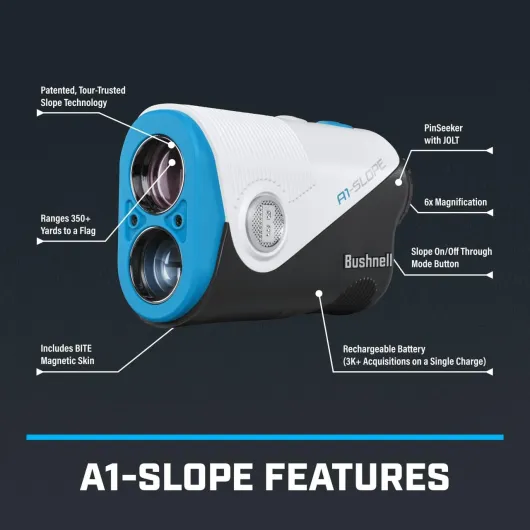
The design is clearly aimed at golfers who want something compact and easy to live with. It’s shorter and slimmer than a lot of the older Bushnell models, and that actually matters in the bag. It doesn’t take up much pocket space in the golf bag, and it’s light enough that you can use it one‑handed without feeling like you’re holding a brick. For smaller hands or younger players, that’s a real plus. My partner tried it and preferred it instantly over my older, bulkier rangefinder.
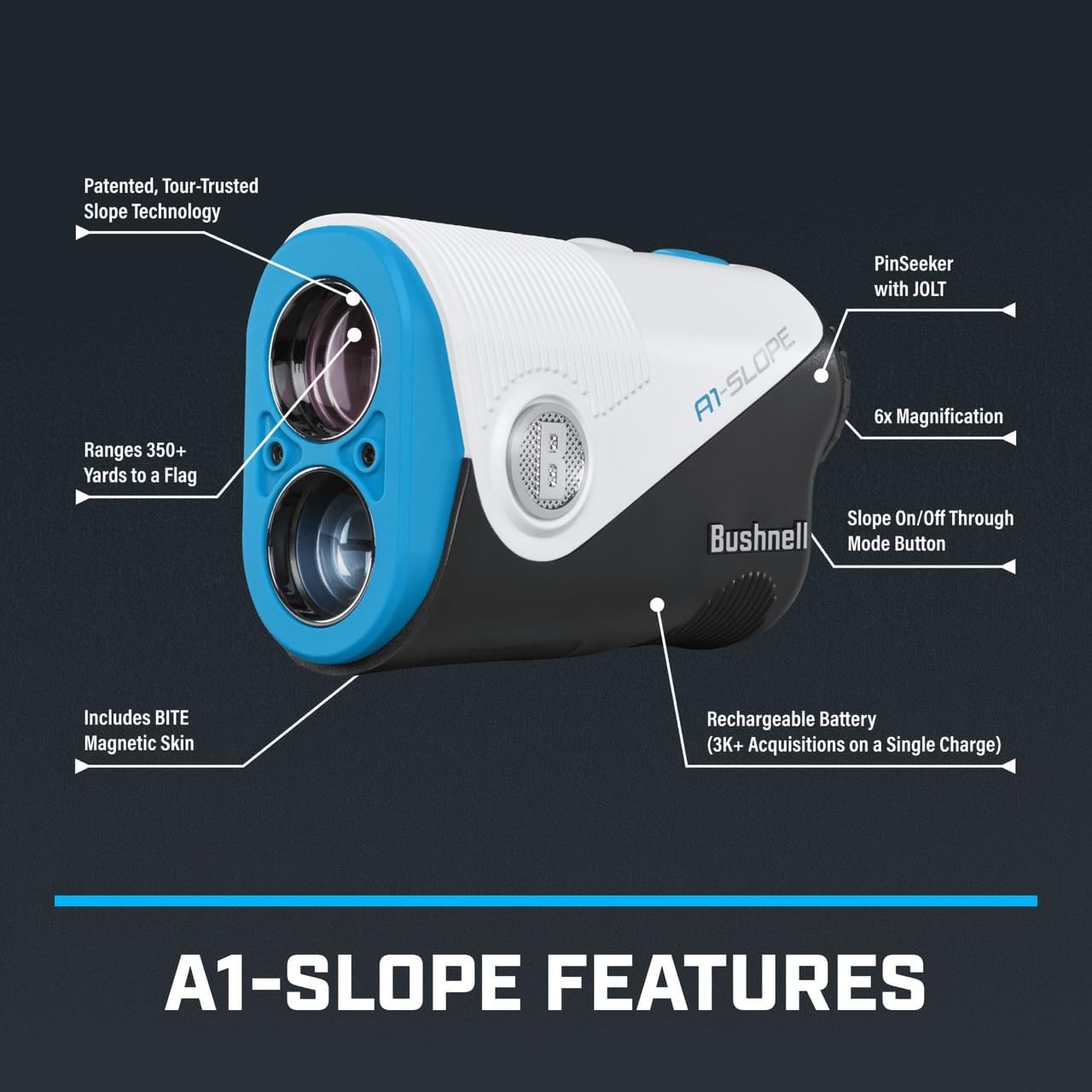
Control‑wise, it stays simple. You basically have a power/measure button and a mode button. The mode button lets you switch slope on and off, which is important if you play in tournaments or at courses that don’t allow slope. The slope toggle is clearly visible, so you’re not guessing what mode you’re in. The eyepiece focuses easily, and the 6x magnification is enough to pick up flags even on longer par 4s and 5s without squinting too much.
The part I’m not totally sold on is the magnetic system. Instead of having a magnet integrated in the actual rangefinder body, Bushnell gives you a magnetic skin (a sort of rubber sleeve with a magnet in it). It works: you can stick it on the cart rail and it holds just fine, even over bumps. But it’s one more thing around the device, and it changes the feel a bit in the hand. Also, if you ever take the sleeve off, you lose the magnet function completely. Some people will like the modular idea; I’d rather have the magnet built‑in and skip the extra layer.
Still, as a whole, the design is pretty practical: compact, clean, and focused on function. No crazy colors, no overcomplicated interface. It looks like a normal Bushnell, just shrunk down and simplified a bit. If you want something flashy, this isn’t it. If you want something that disappears in your hand and in your bag, it works well.
USB‑C rechargeable battery: finally no more random CR2 runs
The battery setup is one of the big reasons I went for this model. It uses a built‑in lithium‑ion battery that you charge via USB‑C. Bushnell claims around 3,000+ target acquisitions per charge, which they translate to about 40 rounds. I obviously haven’t counted every press of the button, but after about 10 full rounds plus a bunch of driving range sessions where I was zapping every flag and target in sight, I still hadn’t killed the battery. I charged it once when I first got it and once more just to be safe before a golf trip, but purely out of caution.
Compared to my old CR2‑powered rangefinder, this is a lot less annoying. No more realizing on the first tee that the battery is dead, then paying a silly price for a single replacement battery in the pro shop. With this, you plug it into the same charger as your phone or laptop. USB‑C is also nice because everyone has one lying around now. I just leave the supplied cable in my golf bag and plug it in the night before a tournament or weekend round if I’m not sure about the level.
The only small downside of a built‑in battery is long‑term: if the battery ever degrades after a few years, you can’t just swap it like a CR2. At that point you’d probably be looking at a repair or a new unit. But honestly, that’s the case with most modern electronics, and for the convenience you get now, I’m fine with that trade‑off. I’d rather have hassle‑free charging for a few seasons than fiddle with disposable batteries.
In day‑to‑day use, the battery is a non‑issue, which is exactly what you want. It just works in the background: you don’t think about it, it doesn’t die mid‑round, and you don’t feel like you’re burning money on new cells every couple of months.
Light, plastic, and water‑resistant – but don’t abuse it
Durability‑wise, this isn’t a tank, but it holds up fine for normal golf use. The body is plastic, which helps keep the weight down, but also means it doesn’t feel bulletproof. I’ve tossed it around in the cart, dropped it onto the grass a couple of times, and had it bump around in the bag. So far, no cracks, no issues with the optics, and the buttons still click like new. The plastic doesn’t feel cheap, just not super premium either. It’s the kind of device you treat with basic care, not something you throw across the parking lot.
It’s listed as water‑resistant, not fully waterproof. I’ve used it in light drizzle and on damp mornings with no problem. The lenses didn’t fog up badly, and the readings stayed consistent. I wouldn’t leave it exposed in a heavy downpour for hours or drop it in a puddle, but for normal bad‑weather golf – bit of rain, some mist, wet cart seats – it’s handled that fine. If you’re someone who plays a lot in the rain, I’d still keep it in the case between shots.
The carry case and the BITE sleeve actually help with durability too. The case has a semi‑hard shell, so if your bag tips over or you toss it in the trunk, it gives the rangefinder a bit of protection. The magnetic sleeve adds a layer of rubber around the body, which helps against light bumps and scratches. It’s not armor, but it’s better than bare plastic banging around.
Overall, I’d call the durability pretty solid for a light, compact unit. It’s clearly made for regular course use, but it’s not indestructible. Treat it like any other piece of golf tech: don’t soak it, don’t throw it, and keep it in the case when you’re not using it, and it should last a good while.
Accuracy, speed, and Slope: the stuff that actually matters
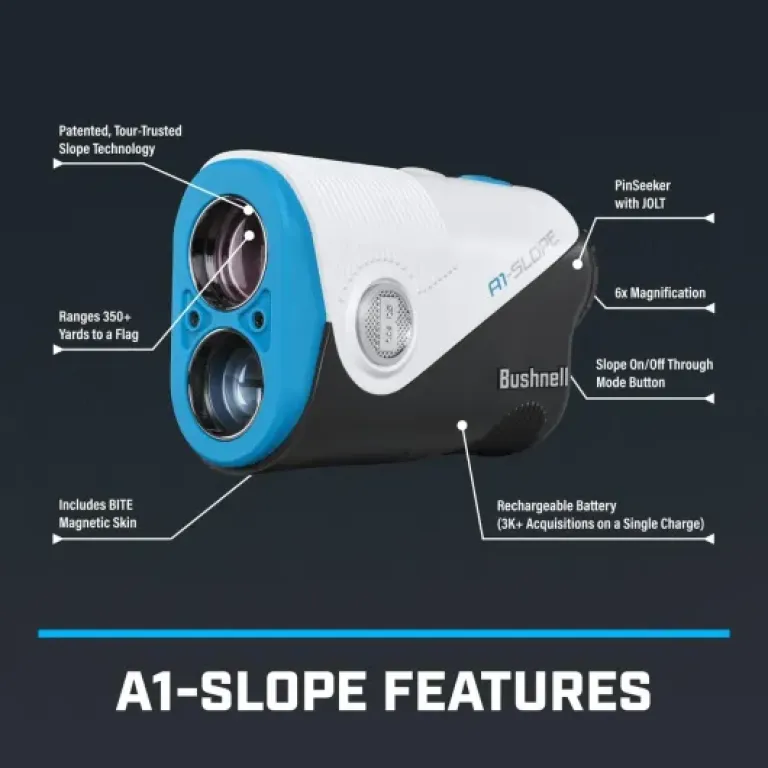
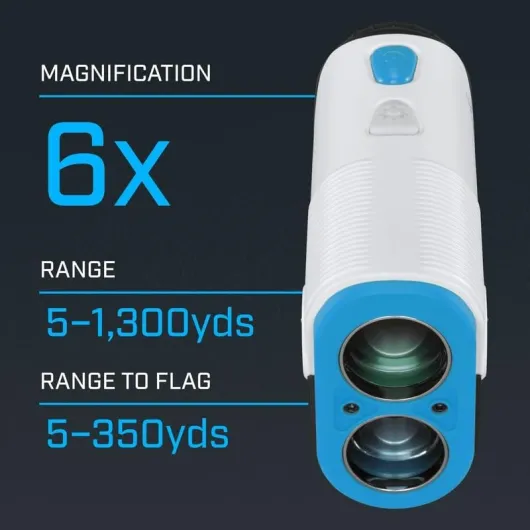
On performance, this is where the A1‑Slope justifies the Bushnell logo. The measuring range is listed as 5–1,300 yards, with over 350 yards to a flag. On a normal course, you’ll basically live in the 70–230 yard range, and in that window it’s rock solid. Distances pop up quickly, and the Pinseeker with JOLT does what it’s supposed to do: it vibrates when it locks onto the flag instead of the trees behind it. I didn’t have many cases where I had to re‑shoot because I wasn’t sure if it caught the right target.
I tested it against a friend’s much pricier Bushnell model and a cheap Amazon rangefinder. Compared to the high‑end Bushnell, the yardages were almost always identical or off by 1 yard, which is basically nothing in real play. Compared to the cheap unit, you could see the difference: the budget one would jump between numbers or grab the background, while the A1‑Slope locked in faster and stayed on the flag. When you’re standing on a par 3 with people waiting, that speed and certainty is actually pretty important.
The slope feature is the other key point. Bushnell’s slope tech is pretty well known, and here it feels the same: you get the raw distance and the adjusted distance for elevation. On hilly courses, it helps with club selection. Is it going to magically fix your swing? No. But it does take some of the guesswork out when you’re hitting uphill or downhill. Being able to switch slope off through the mode button keeps it legal for tournament play, so you’re not stuck choosing between two devices.
Bottom line: in practice, the performance is what you’d expect from a serious rangefinder. It’s quick, consistent, and the slope readout is useful without being confusing. If you’re the kind of golfer who wants reliable numbers more than a million features, this thing checks that box well.
What you actually get in the box and how it feels in hand
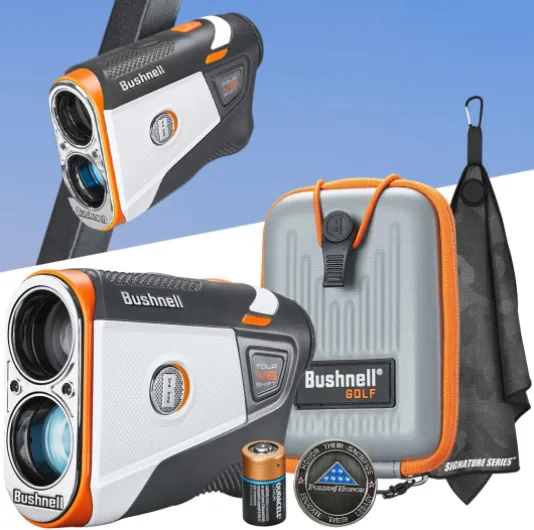
Out of the box, the A1‑Slope looks like a shrunken version of the usual Bushnell units. You get the rangefinder, a BITE magnetic sleeve, a premium carry case, a USB‑C cable, and a basic manual. No batteries included because it has a built‑in lithium‑ion battery. Everything is pretty straightforward: no weird accessories, no fluff. You pull it out, charge it once with USB‑C, and you’re basically ready to go.
The unit itself is small: about 9.5 x 3.6 x 6 cm and only 5.1 ounces. In the hand, it feels light but not like a cheap toy. It’s plastic, but the finish doesn’t feel super flimsy. I’d say it feels like a mid‑range electronic device, not premium metal, but solid enough that I’m not babying it every time I toss it back into the bag. The white/blue color is pretty clean and easy to spot if you drop it in the cart or on the seat.
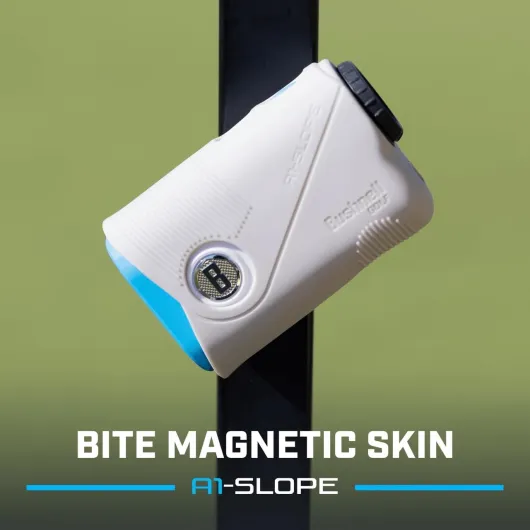
The included case is actually decent. It has a zipper plus an elastic hook so you can keep it half‑open during the round and just slide the unit in and out. The BITE magnetic skin is a separate sleeve that goes around the rangefinder and lets you stick it to a cart bar. Personally, I would’ve preferred the magnet built into the body like some other Bushnell models, but the sleeve does the trick. Just know that it adds a bit of bulk and you’ll probably end up leaving it on all the time.
Overall, the presentation is pretty simple: you get everything you need to use it right away, no surprise extra costs. It doesn’t scream luxury, but it feels like proper golf gear, not a gadget you’ll be embarrassed to pull out on the first tee. For the price point, I think the bundle is fair: you’re paying for the optics and Bushnell tech, not a fancy unboxing experience.
Pros
- Compact and light but still easy to hold steady with 6x magnification
- Fast, consistent yardages with Pinseeker and JOLT that actually locks onto the flag
- USB‑C rechargeable battery with enough life for many rounds and no CR2 hassle
Cons
- Magnet is in a separate sleeve instead of built into the unit
- Plastic build feels more functional than premium
- Not the cheapest option if you only play a few times per season
Conclusion
Editor's rating
After several rounds with the Bushnell A1‑Slope, my honest take is this: it’s a very solid, no‑drama rangefinder that does the basics really well. You get quick and reliable distances, a slope mode that actually helps on hilly holes, and a compact body that doesn’t weigh down your bag. The USB‑C rechargeable battery is a big plus if you’re tired of hunting for CR2 batteries. It feels like a proper Bushnell, just in a smaller and slightly more affordable package.
It’s not perfect. The plastic build is more functional than premium, the magnet being in a separate sleeve isn’t my favorite design choice, and if you’re on a tight budget, there are cheaper rangefinders that will still give you a number. But compared to those budget units, the A1‑Slope is clearly more consistent and easier to use. And compared to the very high‑end Bushnell models, you’re not missing much that matters to an everyday golfer.
Who is it for? Regular golfers, mid‑handicappers, caddies, or anyone who plays enough that they’re sick of unreliable yardages and battery hassles. Who should skip it? People who only play a few times a year and don’t care about slope, or gear heads who want the absolute top model with all the bells and whistles. For most everyday players, though, this hits a very good balance between price, performance, and convenience.