Summary
Analysis score
Average of the criteria rated below
Price-to-feature balance and who gets the best deal
Design, ergonomics and on-course handling (in theory)
Hybrid power: rechargeable plus CR2 backup
Build, protection, and long-term prospects
Accuracy, flag lock, and special modes
What the ACEGMET PFS5 brings to the table
Pros
- Fast and reliable flag lock with vibration, praised even by owners of high-end rangefinders
- Strong feature set for the price: slope switch, scan mode, coach (triangulation) mode, dual red/black display, 7x magnification
- Hybrid power (USB-C rechargeable plus CR2 battery) and strong magnet with included protective case and belt clip
Cons
- Plastic construction with no stated water-resistance rating, so not as robust as some premium metal-bodied competitors
- At least one user notes inconsistent readings for very close objects, suggesting occasional quirks at short range

Specifications
View full product page →| Brand | ACEGMET |
A mid-priced rangefinder aiming at tour-style features
The ACEGMET PFS5 golf rangefinder positions itself as a mid-priced device that tries to bring down features usually seen on more expensive models: 1300-yard stated range, slope with an on/off switch, dual red/black display, 7x magnification, and a strong magnet for cart mounting. On paper, it targets golfers who want something more advanced than entry-level units but without paying Bushnell money. The Amazon rating sits around 4.8/5 from a small pool of reviews, which suggests early buyers are largely satisfied, though the sample size is still limited.
Apart from standard flag-lock and vibration, the brand pushes two ideas: an “EnviroSlope” slope calculation and an “exclusive coach mode” based on triangulation, meant to give distance between two points like ball and pin even when you’re not standing right there. One user even compares it directly with a much pricier Mileseey M1 Pro (around $600) and considers this ACEGMET a serious backup option, especially for flag pickup speed. That kind of comparison gives a decent signal about where this product stands in terms of ambition.
The spec sheet lists a plastic body, 0.62 kg package weight, a compact footprint, and a dual power concept (rechargeable via USB-C plus a CR2 battery). That’s not unique in the market, but it does address a common frustration: dead batteries mid-round. Several reviews insist the magnet is very strong and the finish feels solid, which is reassuring for something that may spend 4–5 hours bouncing around on a cart. The included soft case, lanyard and belt clip round out a fairly complete kit for this category.
In my opinion, the PFS5 looks like a feature-rich option for golfers who care about quick flag locking, visibility of numbers, and cart convenience more than ultralight premium materials. It is not a budget toy, but it undercuts the big brands that offer similar functions. The early feedback is positive on accuracy and usability, with one mixed comment about inconsistent readings at very short distances. So the real question is not whether it works at all, but whether its mix of strengths and compromises makes sense for your own level, budget, and expectations.
Price-to-feature balance and who gets the best deal
The PFS5 sits in the mid-range price bracket, far below the $400–$600 premium models but above the cheapest no-name lasers. One reviewer explicitly compares it to a roughly $600 Mileseey M1 Pro and says that for price/performance, this ACEGMET is the best they’ve found, even calling it an “easy recommendation” as a heavily used backup. That kind of comment is telling: someone who already owns a high-end unit still sees value in this one, not just as a throwaway spare but as a tool they actually use a lot.
Feature-wise, the PFS5 packs quite a lot for its segment: 1300-yard stated range, slope with an on/off switch, dual red/black display, 7x magnification, scan mode, coach mode, strong magnet, dual power (USB-C + CR2), and a complete accessory kit. Many competing devices in the same price area might offer only some of these: maybe slope but no dual display, or a magnet but no scan mode, or single power without a backup battery. In that sense, the spec sheet is ambitious and tries to cover most of what golfers realistically want.
The user feedback is mostly very positive: 4.8/5 from a handful of reviews, with people praising accuracy, ease of use, strong magnet, and build quality. There is one 4-star review that raises a concern about inconsistent readings for nearby objects (e.g., a car and a tree close together showing noticeably different distances than expected). That’s a reminder that at this price level, you’re not buying a survey-grade instrument. For normal golf distances to flags and hazards, the other comments suggest it performs well; for precise short-range objects, there may be occasional quirks.
In my opinion, the value is strong for golfers who want a capable rangefinder without a luxury tax. You get most of the features of premium models at a much lower cost, plus a two-year warranty. It’s not perfect—plastic build, unknown long-term durability, and at least one note of odd readings at very close range—but there’s clearly more upside than downside for typical amateur and even serious recreational players. The people who might not see as much value are those who already own a top-tier Bushnell or similar and are perfectly satisfied, or players who only want a barebones, ultra-cheap device with no interest in slope, scan, or coach modes.

Design, ergonomics and on-course handling (in theory)
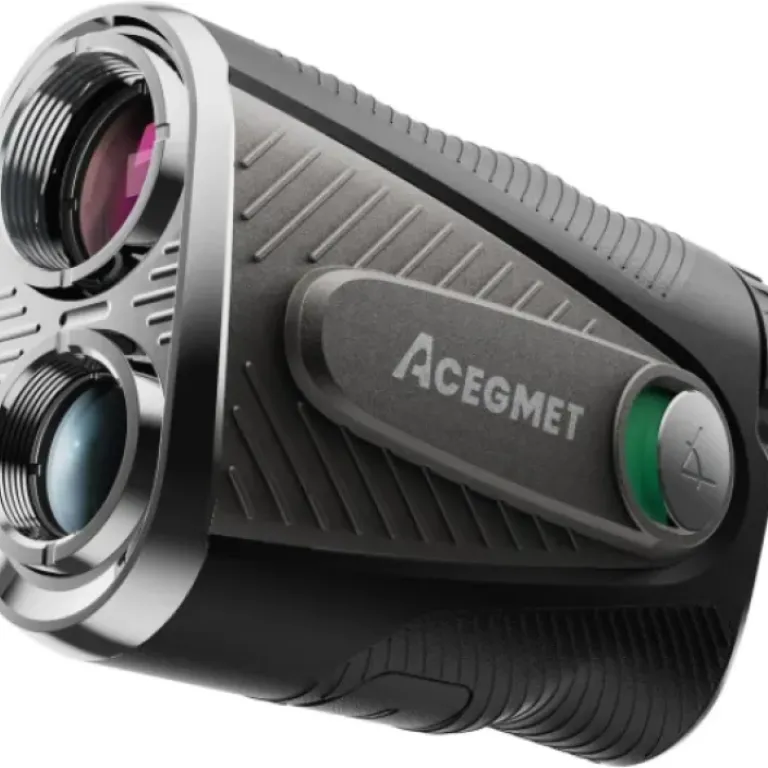
The ACEGMET PFS5 follows a classic monocular rangefinder shape but with some ergonomic tweaks. The listed dimensions are about 2.75 × 4.19 × 1.5 inches, which keeps it compact enough for one-handed use and easy storage in a cart cup holder or bag pocket. The brand highlights an ergonomic curve and a diamond-textured grip. Several reviewers mention that the shape, button placement, and weight feel natural in the hand, and that the buttons are responsive. That suggests the basic layout is sensible: main fire button on top, mode or menu button(s) within easy reach, and not much clutter.
One of the main design talking points is the built-in 5500 Gauss magnet. Buyers repeatedly comment that the magnet is very strong, strong enough to stick firmly to a golf cart frame and stay there over bumpy rides. The kit also includes a magnetic belt clip, which gives another mounting option if you prefer to keep it on your hip rather than on the cart. This approach is pretty common now among modern rangefinders, but not all magnets are equal; the fact that multiple users call out the strength specifically is a good sign for practical use.
The dual red/black display is another key design choice. Instead of forcing you into either a black-only LCD or a red-only OLED-style display, this device lets you switch or combine for readability. One reviewer notes the contrast is easily read and that adjustments in the onboard menu help tune the display. For golfers who play early mornings or late evenings, this could matter a lot more than the raw 1300-yard spec, because poor readability can make even a technically accurate device frustrating on the course.
Overall, the design seems focused on usability rather than show-off aesthetics. It’s plastic, black, and fairly standard looking—no metal chassis or luxury finish. In my opinion, that’s acceptable at this price level. If you want something that looks like a premium gadget, you’ll probably have to pay more or move to brands that emphasize design above all. Here, ACEGMET appears to have put its energy into grip, magnet placement, and display choices. Based on the comments, this tradeoff pays off for golfers who value convenience and quick access more than a flashy look.
Hybrid power: rechargeable plus CR2 backup
The PFS5 uses a dual power system, which is one of its more practical selling points. It supports both a built-in rechargeable setup via USB-C and a removable CR2 battery. The package includes the USB-C cable and a CR2 cell, so you’re not forced to buy anything extra to get started. One review specifically mentions that charging the removable battery is easy and that there is a clear LED indicator for charge status. That sort of detail matters, because unclear battery indicators are a common headache with cheaper electronics.
One golfer who also owns a Mileseey M1 Pro states they wanted something with better battery life and fewer frills as a backup unit, and they consider this ACEGMET the right answer for that need. That comment doesn’t give hard numbers, but it does suggest that, in real use, the device doesn’t drain excessively and that the combination of rechargeable and CR2 power feels reassuring. On paper, this approach should significantly reduce the risk of a dead device mid-round: you can keep the CR2 as a backup and mainly rely on USB-C charging between games.
The manufacturer doesn’t publish a precise number of shots per charge or hours of continuous operation, so any claims about exact endurance would be speculation. However, with a Class 1 laser and a relatively simple display system, typical rangefinders in this category often last multiple rounds before needing a recharge or a new battery. Given that no review complains about poor battery life or sudden shutdowns, and at least one explicitly praises the power setup, there is no obvious red flag here.
In my opinion, hybrid power is a real advantage over single-battery units, particularly for golfers who travel, play tournaments, or just forget to charge gear. USB-C makes topping up easy from power banks or car chargers, while CR2 keeps a traditional backup path. Unless you strongly prefer a purely rechargeable or purely disposable-battery design, this mixed approach looks like a sensible compromise that favors reliability on the course.

Build, protection, and long-term prospects
The ACEGMET PFS5 uses a plastic housing, which is common at this price level but obviously not as premium as metal-bodied models. The package weight is about 0.62 kg (including box and accessories), so the device itself should be relatively light. Several reviewers comment positively on the build, with phrases like “well built”, “good quality materials”, and “finish is quite nice”. One buyer emphasizes that the included case “will surely protect from drops and falls”, indicating that the carrying solution is not an afterthought but a reasonably robust shell with enough padding to handle everyday bumps.
The diamond-textured grip and ergonomic shape should also help with avoiding accidental drops, at least in theory. There is a hand rope (lanyard) included, plus a magnetic belt clip, giving multiple carrying options beyond just leaving it loose in a cart. The strong magnet that attaches it to a cart frame is praised by more than one reviewer, who describe it as exceptionally strong and reliable. A secure magnet matters for durability because a weak magnet can lead to the rangefinder bouncing off the cart over rough terrain, which is a common way for lenses or internal components to get damaged.
There is no explicit mention of water resistance, IP rating, or shock resistance in the public specs. That means you probably shouldn’t assume it’s designed for heavy rain or serious impacts. Most golf rangefinders in this bracket are built to survive light drizzle and normal use but not full immersion or repeated hard drops. One reviewer notes they would have liked lens caps for extra protection, though they also point out that other brands typically don’t include them either. That comment hints that the optics are exposed in a standard way, so keeping the unit in its case or using the lanyard when walking is still a good idea.
The brand advertises a 2-year manufacturer warranty and “lifetime technical support”. A two-year warranty is decent for a mid-range golf accessory and suggests some confidence from ACEGMET in the product’s lifespan. There are no reports in the current reviews of units failing early, which is reassuring, but the total number of reviews is still low, so long-term failure patterns are unknown. In my opinion, if you treat it like typical golf electronics—don’t leave it soaking wet, avoid big impacts, and use the case—the PFS5 should hold up reasonably well. Just don’t expect the same tank-like feeling and potential longevity as some top-tier metal-bodied rangefinders that cost several times more.
Accuracy, flag lock, and special modes
On paper, the PFS5 offers 1300-yard maximum range and ±1 yard stated accuracy, which is pretty standard for serious golf rangefinders. The real interest is how buyers describe its behavior on the course. One reviewer who owns a high-end Mileseey M1 Pro (around $600) directly compares the ACEGMET and says this cheaper unit comes surprisingly close in terms of flag pickup speed. According to that comment, the PFS5 locks onto the flag fast and, more importantly, inspires confidence that the distance shown is actually to the pin and not the background. That same user even says it’s better than many big-name brand rangefinders for flag acquisition speed, which is strong praise in this segment.
Several reviews also mention that the unit is accurate compared to other brands when cross-checked. One buyer states they compared readings with other rangefinders and found this ACEGMET “just as accurate” as the others. Another calls it “very nice” and explicitly says it works flawlessly and provides reliable readings. That suggests the core ranging engine and software are at least in line with expectations for mid-range golf units, not some random gadget-level laser.
The device includes scan mode, highlighted by one user as particularly useful. In scan mode, the rangefinder continuously updates yardage as you sweep across an area. The reviewer gives a practical example: scanning along the edge of a hazard to see which carry distance lines up with their comfort zone. That kind of real-time feedback is something not all budget units handle well, and it can genuinely help with course management for players willing to think strategically rather than just shoot at the pin.
Coach mode, the triangulation feature, draws more mixed reactions. The same reviewer who praises the unit overall says they have never found any rangefinder to be truly precise with triangulation, including this one. Their view is that it’s useful to get you “in the ballpark”, especially on cart-path-only days when you can’t get directly to your ball. So it’s a bonus tool, not something to rely on for exact club selection on every shot. In my opinion, that’s a fair way to think about it: core performance (flag lock, standard ranging) seems to be the strong suit, while coach mode is more of an extra, handy in some situations but not a magic trick.

What the ACEGMET PFS5 brings to the table
The ACEGMET PFS5 is a laser rangefinder for golf with a stated maximum range of 1300 yards and a claimed accuracy of ±1 yard. It offers 7x magnification and a 7.5° field of view, which on paper should be more than enough for typical golf situations from tee to green. It supports both slope and non-slope modes, with a physical slope switch to keep it compliant with tournament rules when necessary. The brand also advertises EnviroSlope, which presumably factors elevation into adjusted yardage, a now-standard feature on mid- to high-end units.
Where it tries to differentiate itself is with its dual red and black display and coach mode. The dual display aims to keep numbers readable in bright sun and in low light situations like early mornings, dusk, or fog. Several buyers say the contrast is good and mention that the display brightness or contrast can be adjusted through the menu, which adds a bit of flexibility. Coach mode uses triangulation: you can measure from one point to another, then from that point to a third, and the device calculates the distance between the first and third points. One user notes that triangulation on any rangefinder tends to be more of an approximation than pinpoint precision, but still finds it useful on cart-path-only days to get a ballpark number.
The kit is fairly complete: the box includes the rangefinder itself, a portable soft case, a magnetic belt clip, a hand rope (lanyard), a user manual, a USB-C cable and a CR2 battery. The device is described as a Class 1 laser, which is standard and considered safe for consumer optics. There is a 24‑month warranty and “lifetime technical support”, which is a plus if the brand actually responds well, though the reviews available don’t go into detail about long-term customer service interactions.
In my view, the PFS5’s presentation is quite straightforward: it aims for tour-level features on paper (slope, fast flag lock, scan mode, long range) while staying in an accessible price band. It doesn’t promise fancy materials or ultra-premium build; instead, it leans on functionality (scan mode, coach mode, dual display) and practicality (magnet, belt clip, dual power). For golfers who want a complete package rather than barebones distance-only gear, this spec sheet is solid and fairly aggressive against its direct competitors.
Pros
- Fast and reliable flag lock with vibration, praised even by owners of high-end rangefinders
- Strong feature set for the price: slope switch, scan mode, coach (triangulation) mode, dual red/black display, 7x magnification
- Hybrid power (USB-C rechargeable plus CR2 battery) and strong magnet with included protective case and belt clip
Cons
- Plastic construction with no stated water-resistance rating, so not as robust as some premium metal-bodied competitors
- At least one user notes inconsistent readings for very close objects, suggesting occasional quirks at short range
Conclusion
Analysis score
The ACEGMET PFS5 looks like a feature-rich mid-range golf rangefinder that focuses on practical use: fast flag lock, a readable dual red/black display, strong magnet for cart mounting, and a hybrid power system with USB-C plus CR2 backup. Early reviewers are largely positive about accuracy and usability, with one owner of a much more expensive Mileseey model saying this ACEGMET comes close in flag pickup speed and is better than many big-name options in that specific area. Scan mode and coach (triangulation) mode add flexibility for hazard management and cart-path-only situations, even if triangulation isn’t precise enough to rely on for every shot.
On the downside, the body is plastic, there’s no stated water-resistance rating, and at least one buyer mentions inconsistent readings for very close objects. The review count is still small, so long-term reliability is not fully documented. That said, a 2-year warranty, solid comments about build quality, and a protective case help offset some of that uncertainty. In my opinion, the overall package delivers good value for money for most golfers who want more than a basic distance-only device but don’t want to pay premium brand prices.
This rangefinder is best suited for: recreational and serious amateur golfers who care about quick, confident flag distances, like the idea of slope and scan modes, and appreciate the convenience of magnet mounting and dual power. Golfers who already own a top-end Bushnell or similar may see it more as a backup than an upgrade. If your priority is rock-bottom price with no extra features, cheaper, simpler lasers exist. But if you want a capable, full-featured unit at a reasonable cost, the ACEGMET PFS5 looks like a solid candidate.