
Summary
Editor's rating
Value for money: who this set actually makes sense for
Looks and shape: not flashy, but sensible
In-hand feel and swing comfort
Forged stainless and basic steel shaft: decent but not premium
Wear, finish, and long-term feel
On-course performance: distance, spin, and forgiveness
What you actually get in the box
Pros
- Three useful lofts (52/56/60) with sensible bounce angles in one affordable set
- Decent spin and consistent distance for casual and mid-handicap golfers
- Solid head weight and full-face grooves that help with forgiveness on slightly off-center hits
Cons
- Feel is firmer and less responsive than premium forged wedges from big brands
- Black finish wears and marks fairly quickly on the face and sole

Specifications
View full product page →| Brand | Roykaw |
A cheap way to fill the wedge gaps
I grabbed this Roykaw 52/56/60 wedge set because I wanted to stop messing around with my random mix of old wedges. My usual setup was a 50° from one brand and a 56° from another, both pretty worn out, and I was missing a proper 60°. This set popped up at a price that was clearly on the budget side, so I went in with low expectations: if they were straight and usable, that was already a win.
I used them over a couple of rounds and a few range and short-game sessions. I’m around a 15–18 handicap, so I’m not a pro, but I can tell when a wedge feels off or when the distance control is weird. I swapped them in directly for my old wedges and tried to play the same shots: 90–100 yards with the 52°, standard bunker shots with the 56°, and high flop-style or short-sided shots with the 60°.
First impression: they don’t feel like top-brand wedges, but they’re also not junk. The heads look fairly compact, the black finish is decent, and the grips are playable out of the box. The feel at impact is a bit firmer than what I’m used to with forged name-brand wedges, but it’s still manageable. The important thing is that the ball goes where you expect most of the time, and these do that reasonably well.
So if you’re expecting the same feedback and spin as wedges that cost two or three times more, you’ll be disappointed. But if you just want a complete wedge set that covers gap, sand, and lob without wrecking your budget, these are actually pretty solid. They’re not perfect, but for an unknown brand at this price level, they’re usable and, in my opinion, good enough for most casual golfers.
Value for money: who this set actually makes sense for
For me, the main selling point of this Roykaw wedge set is simple: you get three functional wedges (52/56/60) for less than the price of a single high-end wedge from a big brand. That alone makes it interesting if you’re on a budget or just don’t feel like dropping a lot of money on short-game clubs. In terms of pure performance per dollar, they’re pretty good. They cover all the key lofts, the bounce angles are sensible, and they’re playable right out of the box.
Where you feel the lower price is in the finer details: the feel isn’t as soft, the finish wears faster, the shafts are generic, and you don’t get any custom options. If you’re picky about lie angle, shaft weight, or grip type, you’ll either have to live with the stock setup or spend extra to tweak them. At that point, you might start creeping into the price territory of used big-name wedges, which could be a better option for more serious players.
I think the sweet spot for these is: beginners upgrading from the ultra-cheap box-set wedges, mid-handicappers who just want a complete wedge setup without overthinking it, or casual golfers who play a few times a month and don’t care about brand logos. If you’re a single-digit handicap who practices short game all the time and is very sensitive to feel and spin, you’ll probably prefer to save up for something from Titleist, Callaway, Cleveland, etc.
So, value-wise, I’d say they’re a good deal as long as your expectations are realistic. They’re not going to magically fix your short game, but they give you a full wedge lineup that’s consistent, functional, and inexpensive. For a lot of weekend golfers, that’s exactly what’s needed: something that gets the job done without emptying the wallet.
Looks and shape: not flashy, but sensible
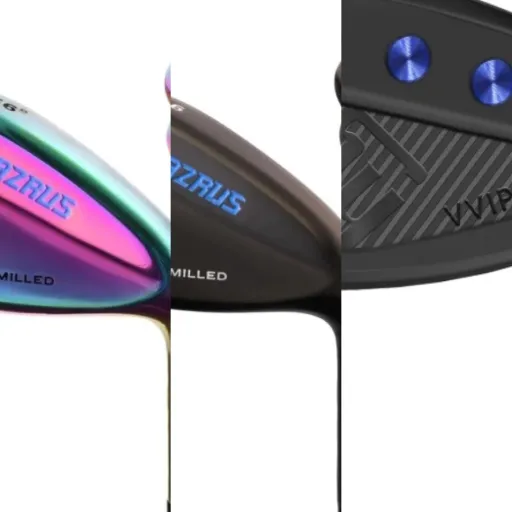
Design-wise, these Roykaw wedges sit somewhere between a traditional players’ wedge and a more forgiving game-improvement style. The head size is slightly on the larger side compared to my old Cleveland wedge, but not huge. At address, the top line isn’t super thick, and the leading edge looks fairly straight, which I liked for full shots and simple chips. The black finish gives them a slightly more modern look, but it’s not some fancy coating; you can tell it’s more about cutting glare and looking decent than anything else.
The sole grind is pretty neutral. There’s some relief at the heel and toe, but nothing crazy. In practice, that means you can open the face a bit on the 56° and 60° without the leading edge coming too far off the ground, but you’re not getting the kind of aggressive grind options you see on top-end wedges. For most mid-handicappers, that’s probably fine. I could play standard pitches, bunker shots, and a few higher, more open-faced shots without feeling like the club was fighting me.
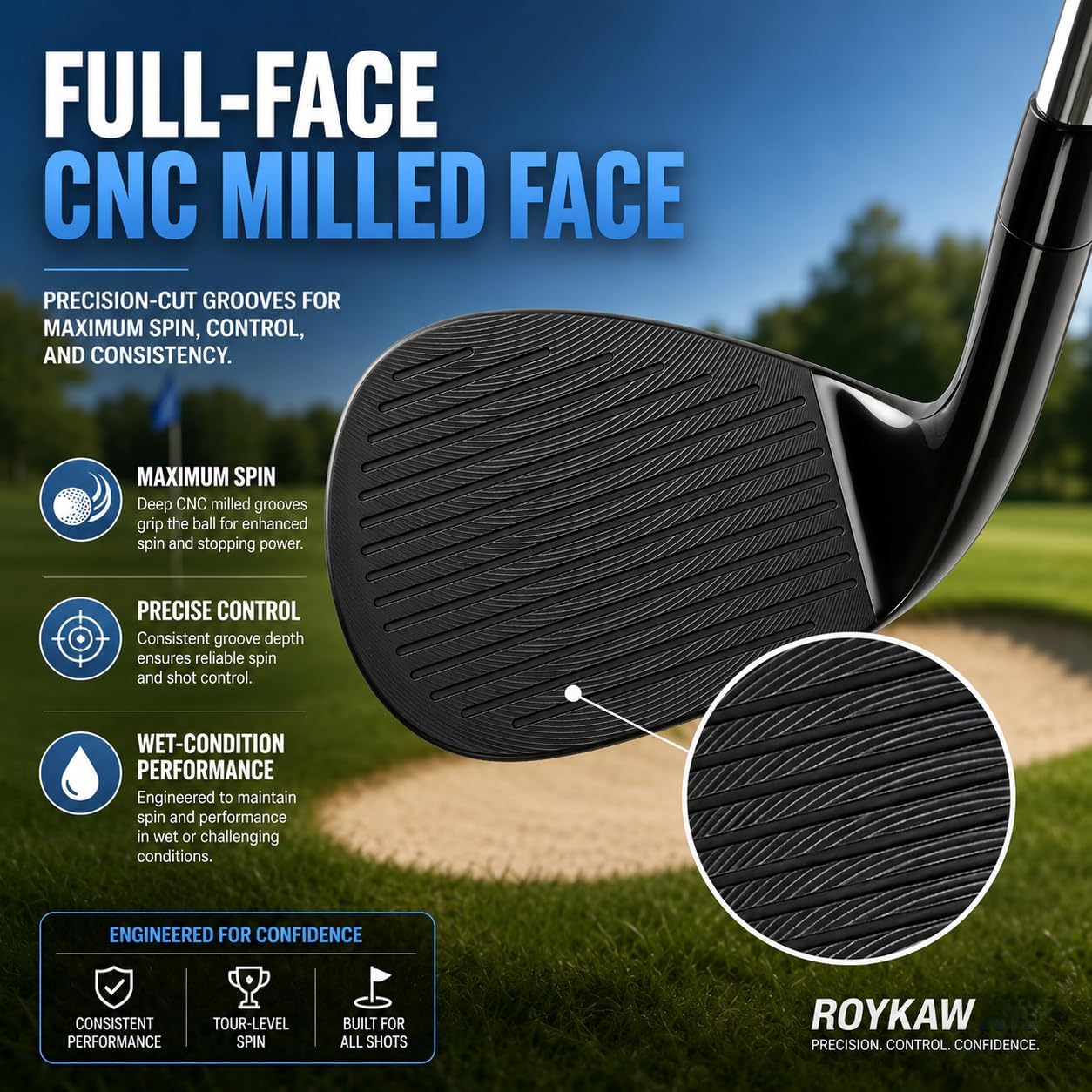
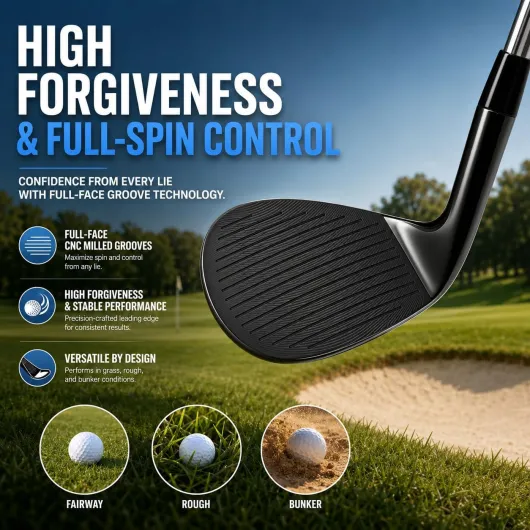
The full-face groove design is one of the more noticeable things visually. The grooves go almost all the way out to the toe, especially on the higher lofts. On the course, that’s handy when you open the face and catch the ball a bit out on the toe—there’s still groove contact instead of a smooth section. It’s not magic, but it helps with those slightly mishit flops or bunker shots. The alignment at address is also decent: the leading edge sits pretty square, and I didn’t feel like I had to fight any weird offset.
The only downside with the design is that the black finish will probably wear off fairly quickly on the face and sole. I already saw some wear marks after a couple of sessions, which is normal for dark wedges, but if you’re picky about looks, they’ll start to look used pretty fast. Personally, I don’t care as long as the performance holds up. Overall, the design is practical: simple shape, neutral sole, and a look that doesn’t scream “cheap,” even if you know they’re not from a big-name brand.
In-hand feel and swing comfort
Comfort for clubs basically comes down to grip feel, swing weight, and how the club reacts on mishits. On these Roykaw wedges, the first thing I noticed was the grip size and texture. They’re standard size, which worked fine for me with a glove on. The rubber has enough texture that I never felt like the club was slipping, even when my hands got a bit sweaty. They’re not super cushioned, but they do absorb a bit of vibration. On thin shots, you still feel it in your hands, but it’s not painful.
In terms of swing comfort, the head weight and balance felt pretty natural. I didn’t feel like I had to adjust my swing much switching from my previous wedges to these. On full swings with the 52° from about 90–100 yards, the club felt stable through impact and didn’t twist much, even on slight toe hits. On shorter pitches and chips, I could feel the head enough to control the length of the swing, which matters a lot for distance control. If a wedge feels too light, I tend to overswing; that didn’t happen here.
The feel at impact is on the firmer side, but not harsh. When you catch it clean, you get a pretty clear “click” and a solid sensation in the hands. When you hit it a bit thin or toward the toe, you definitely feel it, but it doesn’t send a shock up your arms. The brand talks about reduced vibration, and while that sounds like marketing, in practice I’d say these are about average in that department. They’re not super soft, but they’re not punishing either.
Overall comfort is good enough that I didn’t think about the clubs much while playing, which is honestly what you want. They don’t fight you, they don’t feel awkward at address, and they don’t feel like rebar in your hands. If you’re very sensitive to feel and love super soft forged wedges, these will feel a bit basic. But for most mid- to high-handicap players, the comfort level is totally fine for regular use.
Forged stainless and basic steel shaft: decent but not premium
The brand advertises these as forged stainless steel heads with stainless steel shafts and standard rubber grips. In hand, they feel solid enough. The head weight is actually one of the things I liked: there’s enough mass there to feel the clubhead through the swing, which helps with tempo and distance control. Compared to some very cheap box-set wedges I’ve tried, these don’t feel hollow or tinny at impact. The sound is a bit sharper than my older forged carbon steel wedges, but not harsh.
The shafts are regular flex steel, nothing fancy like Dynamic Gold or KBS. They feel closer to a mid-weight shaft. If you’re used to premium wedge shafts, you’ll probably notice that these feel a bit more generic. For most casual golfers, though, they’re fine. I didn’t feel any weird whippy behavior or excessive stiffness. On half swings and three-quarter shots, the shaft felt stable enough, and my dispersion was about what I’d expect from a normal wedge shaft.
The grips are standard black rubber, supposedly non-slip and sweat-absorbent. I played one round in slightly damp conditions, and they held up fine. They’re not super tacky like some premium grips, but they don’t feel like cheap plastic either. If you’re picky about grips, you might want to regrip them after a while, but out of the box they’re perfectly usable. The main positive here is you don’t have to regrip them immediately, which is often the case with very low-cost clubs.
Overall, the materials feel like mid-range quality: clearly not top-tier, but not toy-level either. The forged stainless is firmer than softer carbon steel wedges, so if you’re used to that buttery feel, you’ll notice the difference. But in practice, the build is sturdy, nothing rattled, and I didn’t see any obvious defects. For the price point, I’d call the materials pretty solid, just don’t expect the same feel and fine-tuning you’d get from the big brands’ wedge lines.
Wear, finish, and long-term feel
Durability is always a question mark with lesser-known brands. After a couple of rounds and some range work on mats and grass, the first thing I noticed was wear on the black finish. The faces started to show shiny spots where the ball makes contact, and the soles had visible scratching from sand and turf. That’s totally normal for dark-finished wedges, even from big brands, so I’m not shocked. If you expect the black to stay perfect, you’ll be disappointed, but functionally it’s not an issue.
The grooves themselves still looked sharp after my testing. The CNC milling lines were still visible, and I didn’t see any obvious rounding or chipping. I hit quite a few balls out of a practice bunker and didn’t notice any sudden drop in spin or control, so at least in the short term, the faces hold up fine. Over a full season, I’d expect them to wear like any other wedge: if you play a lot, you’ll eventually see some loss of sharpness, but that’s just wedge life in general.
The shafts and grips held up with no issues. No rust spots, no loose heads, no twisting. The grips didn’t start peeling or getting shiny immediately, which is a good sign. Long term, I’d probably regrip them after a year or so, but that’s standard. The ferrules stayed in place and didn’t start creeping up, which is something I’ve actually seen on cheap clubs before, so that’s one less thing to worry about.
Overall, the durability seems acceptable for the price range. The finish will wear and they’ll start to look used fairly quickly, but the structural side (head, shaft, grooves) feels solid enough. If you’re playing a couple times a month, I can see these lasting you a few seasons before you really need to think about replacing them for performance reasons. Not bulletproof, but definitely not disposable either.
On-course performance: distance, spin, and forgiveness
Performance is where I was most curious, because a cheap wedge that looks nice but can’t spin or control distance is pointless. I’ll break it down by loft. The 52° basically replaced my gap wedge. On the course, from 90–100 yards, distances were pretty consistent. I wasn’t suddenly flying greens or coming up way short. Compared to my old wedge, I’d say carry distance was within a couple of yards, which is totally fine. Dispersion left-right was also normal for my swing, so no weird face angle issues.
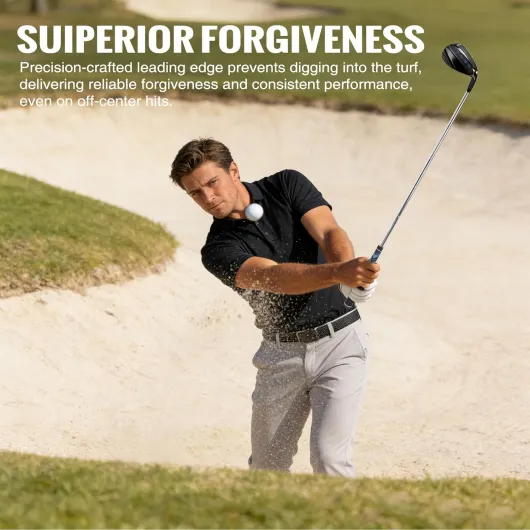
The 56° is the workhorse: pitches from 60–80 yards, bunkers, and standard chips. Out of fairway lies, it launched on a medium-high trajectory, nothing crazy high, and stopped reasonably well on the greens. I’m not spinning balls back like a tour pro, but I did notice that well-struck shots would check and stop instead of rolling out forever. Out of bunkers, the 12° bounce helped a lot. The sole didn’t dig much, even in softer sand, and I could get the ball out reliably. It’s not magic, but it does what you want a sand wedge to do: slide under and pop the ball up.
The 60° is more of a specialty club for me. I used it for short-sided chips, flop attempts, and some bunker shots where I needed more height. Here, the full-face grooves were actually useful. On a couple of open-face shots where I caught the ball closer to the toe, it still had enough spin and height to land soft. Again, not pro-level spin, but enough to stop the ball quickly on medium-fast greens. Distance control with the 60° takes some practice, as always, but once I adjusted, it behaved predictably.
In terms of forgiveness, these wedges are decent. You still get punished if you hit it way behind the ball or blade it, but small mishits don’t completely kill the shot. The lower center of gravity design seems to help get the ball up in the air without needing a perfect strike. Overall, performance is “solid for the price”: not on the same level as high-end wedges, especially in terms of spin and feel, but absolutely usable for weekend golfers who just want consistent results without paying a fortune.
What you actually get in the box
The set comes with three wedges: 52°, 56°, and 60°, all right-handed, regular flex steel shafts, standard rubber grips, and a black finish on the heads. That’s it. No headcovers, no fancy packaging, just a basic cardboard box with the three clubs inside wrapped in plastic. It feels more like something you’d get from a discount golf shop than a premium unboxing, but honestly, I don’t really care about the box for wedges.
Specs-wise, the brand lists the 52° with 9° bounce, the 56° with 12° bounce, and the 60° with 10° bounce. That’s a pretty standard spread and actually useful for a normal amateur setup. The 56° with 12° bounce worked well for me in softer bunkers, and the 52° slotted in nicely between my pitching wedge and my old 50°. The 60° with 10° bounce is more for higher shots and short-sided lies; it’s not some crazy ultra-low bounce lob wedge, which is probably better for most average players anyway.
The clubs are marketed as forged stainless with CNC-milled grooves and a low center of gravity design. Obviously, I can’t cut them open to check any of that, but in hand they do feel like they have a bit more head weight than some super-light budget wedges I’ve tried before. The faces have visible milling and full-face grooves, which is a nice touch for the price, especially on the 60° where you might hit closer to the toe on open-face shots.
Overall presentation is very no-frills: you get three functional wedges with coherent lofts and bounce angles, and that’s about it. If you’re looking for something gift-worthy or “premium feeling” out of the box, this isn’t it. But if you just want three new wedges that arrive straight, undamaged, and ready to play, they tick that box. For the money, I think the value is decent, as long as you’re not expecting all the extras.
Pros
- Three useful lofts (52/56/60) with sensible bounce angles in one affordable set
- Decent spin and consistent distance for casual and mid-handicap golfers
- Solid head weight and full-face grooves that help with forgiveness on slightly off-center hits
Cons
- Feel is firmer and less responsive than premium forged wedges from big brands
- Black finish wears and marks fairly quickly on the face and sole
Conclusion
Editor's rating
Overall, the Roykaw 52/56/60 forged wedge set is a solid budget option if you just want a complete wedge setup that works. The three lofts cover the key gaps, the bounce angles are reasonable, and on the course they perform about as well as many mid-range wedges I’ve tried. You get decent spin, predictable distances, and enough forgiveness for typical mid- to high-handicap swings. The feel is a bit firmer than premium forged wedges, and the black finish wears fairly quickly, but nothing that affects actual play in a big way.
I’d recommend these to newer golfers looking to upgrade from starter clubs, or to casual players who don’t want to spend big on wedges but still want a proper 52/56/60 setup. They suit someone who plays a few times a month, cares more about function than brand, and is fine with some cosmetic wear. On the other hand, if you’re very particular about feel, already play name-brand wedges, or practice your short game a lot and rely heavily on spin and shot shaping, you’ll probably be happier with higher-end or custom-fit wedges, even if you have to buy them one by one.
So, not mind-blowing, but definitely usable and, in my opinion, good value for what they cost. They get the job done, cover all the key short-game situations, and are a reasonable step up from the really cheap stuff without jumping into premium pricing.