
Summary
Editor's rating
Value for money: where it stands versus pricier brands
Design and ergonomics: simple, compact, a bit plasticky but practical
Battery and charging: USB‑C is nice, and it just keeps going
Build quality and durability: decent for the price, but not indestructible
On-course performance: accuracy, speed, and flag lock in real use
What you actually get in the box and how it feels out of the gate
Pros
- Accurate yardages within about 1 yard of pricier rangefinders in typical golf distances
- USB‑C rechargeable battery with long life, no need for CR2 batteries
- Useful features for the price: slope on/off, flag lock with vibration, strong magnet, and belt clip
Cons
- Optics and overall build feel clearly less premium than big‑name competitors
- IP54 rating and plastic body mean it’s not ideal for heavy rain or rough handling

Specifications
View full product page →| Brand | REDTIGER |
A budget rangefinder that doesn’t feel like a toy
I’ve been using this REDTIGER golf rangefinder for a few rounds now, plus a couple of range sessions, and I’ll be honest: I went in a bit sceptical. The price is on the low side compared to Bushnell and Nikon, so I was expecting something that felt cheap or gave flaky distances. That’s not what I got. It’s still a budget device, but in actual use it feels more like an older mid‑range model from a big brand than a random no‑name gadget.
The first thing I noticed on the course was how quickly it locks onto flags once you get used to the button timing. There’s a short vibration when it picks up the pin, and most of the time the yardage lined up with what my playing partners were getting on their more expensive units. I checked it a few times against a Bushnell and GPS watch, and the numbers were usually within a yard or two, which is more than good enough for amateur golf.
What surprised me most is how handy the little details are: the magnetic strip to stick it on the cart, the belt clip, and the USB‑C charging. I didn’t think I’d care about those things, but not having to worry about batteries and not digging in the bag every single shot is actually pretty nice in practice. It’s not perfect – the optics aren’t as bright as premium brands and it can struggle a bit in shaky hands at longer ranges – but for normal golf distances it gets the job done without drama.
If you’re expecting a pro‑level, super rugged unit that survives abuse and torrential rain, this isn’t that. But if you’re a weekend golfer or someone getting tired of guessing yardages or relying only on GPS, this is a pretty solid step up without emptying your wallet. That’s basically how I’ve been using it: a simple, practical tool, not a trophy gadget.
Value for money: where it stands versus pricier brands
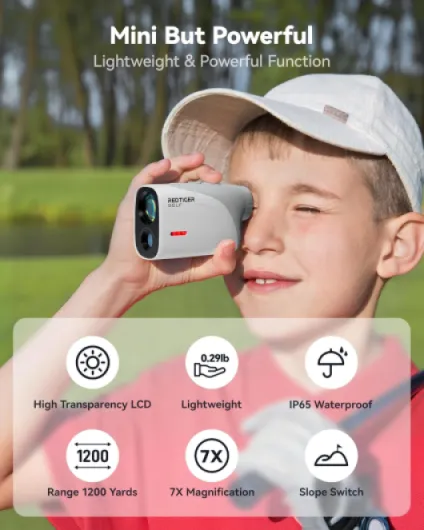
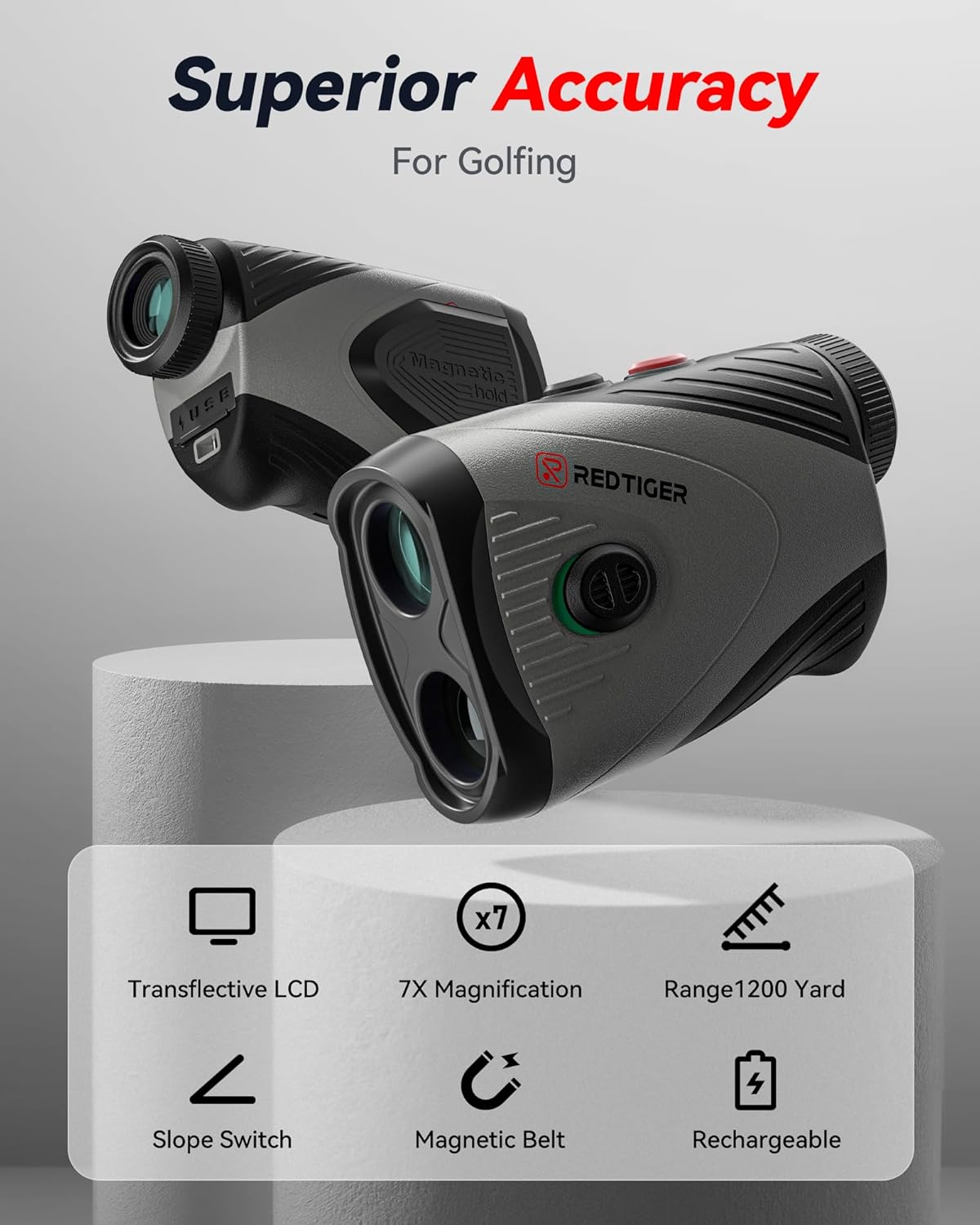
On value, this is where the REDTIGER rangefinder makes the most sense. You’re getting a device with flag lock, slope on/off, 7x magnification, USB‑C charging, and a strong magnet for a fraction of what a top Bushnell or Nikon costs. In actual play, the yardages are close enough that most golfers won’t notice a difference. When I compared it side by side with a friend’s high‑end unit, the only real differences were slightly clearer optics and slightly faster, more confident flag locking on the expensive one.
So what are you giving up for the lower price? Mostly brand prestige, a more premium feel in the hand, and probably some extra long‑term durability and waterproofing. The REDTIGER is plastic, light, and feels like a well‑made budget product, not a premium tool. If you’re the sort of golfer who likes having top‑shelf gear for everything, this might feel a bit basic. But if you care more about function than logo, it’s hard to argue against the value here.
From a practical standpoint, you get: accurate distances, usable slope info, good battery life, and convenient mounting options. That covers 95% of what a normal golfer actually needs from a rangefinder. The extra modes (height, speed, etc.) are a bit of a bonus but not a reason to buy. For someone buying their first rangefinder or replacing an old one that died, this sits in a very comfortable spot: cheap enough not to hurt, solid enough that you don’t feel like you cheaped out.
If you play once a month and are just tired of pacing off yardages from sprinklers, this is plenty. If you’re competing seriously every week and playing in all kinds of weather, you might still lean toward a big brand for the extra robustness and slightly better optics. But purely in terms of value for what you pay, this REDTIGER is pretty hard to fault. It’s good, honest gear at a sensible price, with the usual caveats about not abusing it.
Design and ergonomics: simple, compact, a bit plasticky but practical
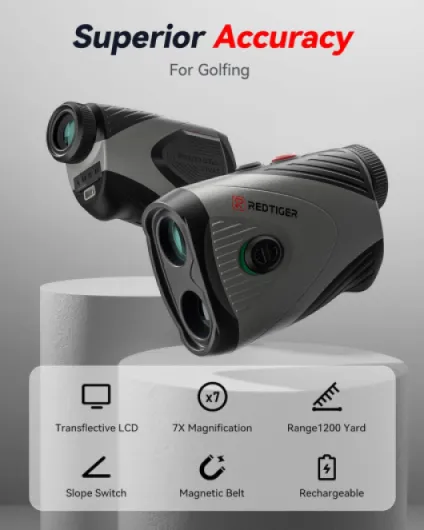
The design is pretty straightforward: compact rectangular body, slightly curved edges, and a rubberized area where your fingers rest. It’s sized well for one‑handed use. I’ve got average‑sized hands and can easily hold it steady with my index finger on the main button. If you’ve got very big hands, it might feel a bit small, but not to the point of being awkward. The eyepiece has a diopter ring to adjust focus, which worked well for me even wearing contacts. Once I set it, I didn’t have to touch it again.
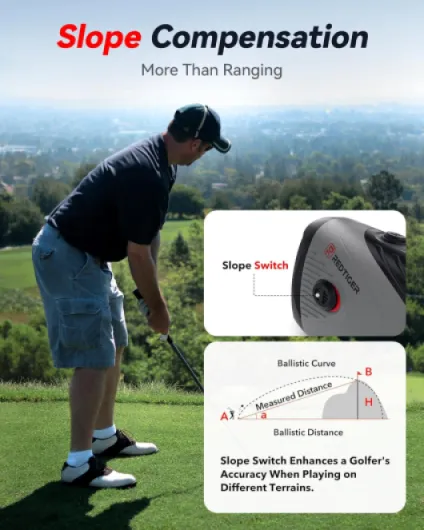
Button placement is logical: power/measure at the front, mode/units behind it. They’re raised enough that you can feel them with a glove on. The slope switch on the side is a physical slider, not a touch button, and that’s a good thing. You can flick it with your thumb and instantly see whether slope is on or off. When slope is on, you get the straight line distance plus the “plays like” yardage based on elevation. For hilly courses, that’s genuinely useful.
The magnetic strip is built into the side of the unit, and it’s strong. I stuck it to a cart frame and to a club head, and it didn’t fall off even on bumpy paths. The separate magnetic belt clip is honestly better than I expected. I clipped it to my belt and walked 18 holes; the rangefinder stayed put and was easy to grab between shots. If you’re someone who constantly loses stuff in your bag, this design really helps keep it accessible.
The only downside on design for me is the overall finish. It’s clearly plastic, and while it doesn’t feel fragile, it doesn’t give that dense, rubber‑armored feel you get from higher‑end brands. Also, there’s no built‑in lens cover, so you’ll want to actually use the case or at least be careful tossing it into a pocket with tees and coins. Still, in daily use, the design is practical and focused on function more than looks, which is fine by me.
Battery and charging: USB‑C is nice, and it just keeps going
The battery situation is one of the stronger points of this rangefinder. It uses a built‑in rechargeable lithium battery and charges via USB‑C, which is so much better than hunting for CR2 batteries. I charged it fully once out of the box, played three full 18‑hole rounds plus two range sessions, and the battery indicator still wasn’t empty. The brand claims around 30,000 uses per charge. I’m not counting shots obviously, but based on my usage, you’re easily getting multiple rounds before needing to plug it in.
Charging is straightforward: plug any normal 5V/2A USB‑C charger or power bank into it. From low battery to full, it took roughly 2 hours for me with a standard phone charger. There’s no fancy fast‑charge, but honestly it doesn’t need it. I just treat it like a GPS watch: top it up every few rounds or the night before a comp if I remember. Even if you forget, 10–15 minutes on a charger before the round is likely enough to get you through 18 holes.
The downside with an internal battery is obvious: if it dies mid‑round and you have no power bank or cable, you’re done, unlike a CR2 battery you could swap. But with how long this one lasts, you’d have to really neglect charging it for that to happen. I’d have preferred a simple percentage indicator instead of just a small icon, but that’s nitpicking. The icon gives a rough idea and that’s usually enough.
In practice, the battery has not been an issue at all. No random shutdowns, no obvious drain from leaving it in the bag. I left it in the trunk for a few days between rounds and it didn’t suddenly drop to zero. For anyone already drowning in chargers and cables, at least this uses the same USB‑C you probably already have for your phone or headphones. So from a day‑to‑day standpoint, the battery and charging are basically set‑and‑forget, which is what you want with this kind of gear.
Build quality and durability: decent for the price, but not indestructible
In terms of durability, I’d call this rangefinder solid enough for normal golf use, but I wouldn’t treat it like a rugged outdoor tool. The body is plastic with some rubberized sections, and it’s rated IP54, which means it handles splashes and dust but is not meant for full soaking. I played one round in light drizzle and had no issues: no fogging, no weird button behaviour. I wiped it off after the round and everything was fine. I wouldn’t be confident using it in a heavy downpour for 4 hours without keeping it in the case between shots.
I’ve had it bouncing around in a cart cup holder and hanging off the belt clip for a few rounds. No cracks, no rattles, and the buttons still feel the same. The magnetic strip hasn’t weakened and the belt clip hasn’t warped. I did accidentally drop it once from about waist height onto a fairway path (hard packed dirt and small stones). It got a small scuff on the corner but worked perfectly afterwards. That gave me a bit more trust in the build, even if it doesn’t feel as tank‑like as more expensive brands.
The lenses haven’t scratched so far, but there’s no flip‑down cover, so you do need to be a bit careful. Tossing it into a pocket full of tees and coins every hole would probably mark it up over time. The included case is your friend here. The zipper and stitching on the case look okay, not premium but not flimsy either. For a season or two of regular weekend use, I don’t see any immediate red flags.
Overall, durability is “good enough” for a careful golfer, not for someone who trashes their gear. If you store it in the case, don’t leave it baking on the dashboard in summer, and avoid soaking it in heavy rain, it should last. If you want something you can throw around like a range ball basket, you’ll probably need to pay more for a proper ruggedized model. For the price, I’m satisfied, but I’m also not pretending it’s bulletproof.
On-course performance: accuracy, speed, and flag lock in real use
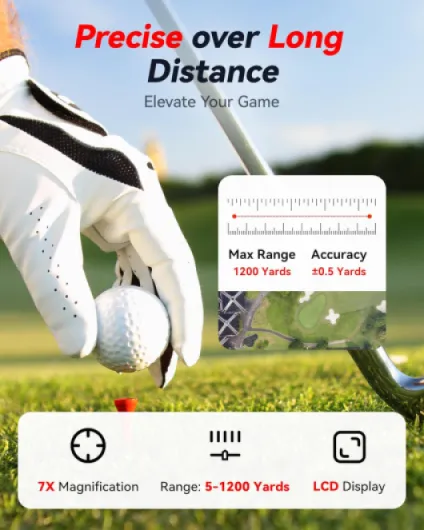
Performance‑wise, this thing does what it claims, within reason. The advertised range is up to 1200 yards, but for golf that’s mostly irrelevant. What matters is 50–300 yards, and in that window it’s pretty solid. I tested it against a friend’s Bushnell on a par 3 and a few approach shots. Distances were usually within 1 yard of each other. For example, his unit said 152, mine said 151 or 152. On a 100‑yard wedge shot, both gave 100. For club selection, that difference is basically nothing.
Flag lock is generally quick as long as your hands aren’t shaking like crazy. You press and hold the button, sweep past the flag, and when it picks up the pin you get a little vibration and the distance locks. On clear days with visible flags, it worked very well. On one hole with trees behind the green, it did sometimes lock onto the background first, but that’s pretty common even on pricier models. A second or third scan, focusing more steadily on the flag, usually sorted it out.
The 7x magnification helps a lot when you’re over 180 yards out, but it’s not the brightest or sharpest lens I’ve looked through. It’s good enough to see the flag and basic detail, but if you’ve used a top‑tier rangefinder before, you’ll notice the difference in clarity and contrast. That said, I had no problem picking out flags up to around 250–260 yards. Beyond that I don’t really try to laser pins anyway – I’m just aiming for general targets.
One thing I did like is the continuous scan mode. Holding the power button lets you pan across bunkers, trees, and the flag and see the numbers update live. That’s handy when you’re trying to see carry distances over a hazard versus how far to the back of the green. The extra modes like speed measurement and height are more of a gimmick for golf, in my opinion. They work, but I don’t see many golfers using them regularly. Overall, for normal golf use, the performance is more than good enough, but it’s not miracle‑level tech. It’s a reliable, no‑drama tool if you accept the occasional re‑scan on tricky targets.
What you actually get in the box and how it feels out of the gate
Out of the box, the REDTIGER rangefinder looks and feels more serious than the price suggests. You get the unit itself, a soft but structured case with a zipper and a small carabiner, a magnetic belt clip, a short USB‑C cable, a hand strap, and a basic manual. No nonsense extras, but everything you need is there. The case is decent: it’s not some hard shell tank, but it protects the device fine in a golf bag pocket and doesn’t take much space.
The rangefinder is surprisingly light at around 180 g, so it doesn’t drag down your belt or overstuff a pocket. When I first picked it up, I was expecting hollow plastic vibes, but the body feels reasonably solid. The two top buttons (power/measure and mode/units) have a clear click, not mushy. There’s also a physical slope on/off switch on the side, which is nice because you can see at a glance if it’s in tournament‑legal mode instead of digging through menus.
Setup is basically nothing: charge it via USB‑C, hold the power button to wake it, look through the eyepiece, and press again to shoot the target. Holding the power button activates scan mode, where you can sweep across different targets and see distances update. Switching between yards and meters is one press on the secondary button. I didn’t have to touch the manual except to check what the different icons meant for the extra modes (speed, height, etc.), which I’ll be honest, I probably won’t use for golf.
Overall, the presentation is straightforward: it looks like a normal golf rangefinder, behaves like one, and doesn’t feel like a toy. If you’ve used a Bushnell or similar, you’ll understand this unit in about 30 seconds. The only thing that feels obviously “budget” is the branding and finish – it’s fine, but nothing flashy or premium. For the price bracket, that’s totally acceptable.
Pros
- Accurate yardages within about 1 yard of pricier rangefinders in typical golf distances
- USB‑C rechargeable battery with long life, no need for CR2 batteries
- Useful features for the price: slope on/off, flag lock with vibration, strong magnet, and belt clip
Cons
- Optics and overall build feel clearly less premium than big‑name competitors
- IP54 rating and plastic body mean it’s not ideal for heavy rain or rough handling
Conclusion
Editor's rating
Overall, the REDTIGER Golf Rangefinder is a solid, no‑nonsense option if you want laser distances without paying premium brand prices. It’s accurate enough for real golf, the flag lock and vibration work reliably once you get used to it, and the slope on/off switch is handy if you bounce between casual rounds and competitions. The USB‑C rechargeable battery and strong magnet are genuinely useful in day‑to‑day use, not just marketing points. It feels like a well‑built budget tool rather than a cheap toy, which is basically what most people in this price range are looking for.
It’s not perfect. The optics aren’t as bright as top‑end models, long‑range flag hunting with shaky hands can take a couple of tries, and the plastic build and IP54 rating mean you still need to treat it with reasonable care, especially in bad weather. If you’re rough on equipment or want something that feels truly premium, you’ll probably still gravitate to the big names and pay extra for it.
If you’re a weekend golfer, a mid‑handicapper, or someone buying their first rangefinder, this is a very sensible choice. It gives you the key features and reliable performance at a fair price. Gear snobs might turn their nose up at the brand, but in actual use, it gets the job done with minimal fuss. If you want top‑tier optics and tank‑like build, look elsewhere. If you want straightforward yardages, decent build, and strong value, this REDTIGER is well worth considering.