
Summary
Editor's rating
Is it worth the money?
Small, light, and a bit toy-like – in a good way
Rechargeable battery that you mostly forget about
Build quality and weather resistance in real life
Accuracy and speed on the course
What you actually get in the box
Pros
- Very compact and light, genuinely pocketable and easy to carry
- Rechargeable USB-C battery with enough life for several rounds
- Good accuracy and fast flag lock with vibration for the price
Cons
- Plastic build and optics feel less premium than higher-end brands
- Can occasionally lock onto background objects in busy scenes

Specifications
View full product page →| Brand | REDTIGER |
A pocket rangefinder that’s actually usable
I’ve been using the REDTIGER Mini Golf Range Finder (GolfVue Series 3) for a few rounds now, plus a couple of sessions on the range and in the garden just to mess around with the distances. I’m not a pro, just a regular weekend golfer who was tired of guessing if the flag was 130 or 150 out. I wanted something small, simple, and not stupidly expensive. This one kept popping up with good reviews and a decent price, so I gave it a shot.
First impression: it’s tiny and light. When I pulled it out of the box I honestly thought they’d sent me a kids’ toy. It weighs basically nothing and fits in the palm of my hand. I was a bit worried that meant “cheap and flimsy”, but after a few rounds in typical mixed weather (bit of drizzle, some wind, bag thrown around in the boot), it’s still fine.
On the course, I mainly used it for approach shots between 80–180 yards and a few tee shots on par 3s. The flag lock with vibration works as advertised most of the time: press, sweep across the flag, it vibrates, and you get a number. When it works, it’s fast and honestly pretty handy. There were a few moments where it grabbed trees behind the green, but that’s fairly normal with most rangefinders in this price bracket.
Overall, my first takeaway is this: it’s not perfect, but it absolutely gets the job done for casual and regular golfers. You get clear distances, decent speed, and a very small gadget that doesn’t weigh your bag down. If you’re expecting tour-level optics and military-grade build quality, this isn’t that. But if you want something compact, rechargeable, and reasonably accurate, it’s off to a good start.
Is it worth the money?
For what it costs (usually well under the top brands), I’d say the REDTIGER Mini offers good value for money. You get accurate-enough distances, fast flag lock, slope mode, IP65 water resistance, a proper case, a magnetic mount, and a rechargeable battery. If you compare that to the big-name rangefinders that cost two or three times more, the main differences are the feel in the hand, slightly better optics, and maybe slightly quicker or more reliable flag lock. For most casual and mid-handicap golfers, those extras are nice, but not essential.
Where it really scores is size and convenience. It’s so small and light that you actually use it all round, instead of leaving it in the bag because it’s a hassle. For me, that alone justifies the price. I’d rather have a compact, decent device I use every shot than a fancy one that feels like a brick. Add in the USB-C charging and the solid case, and it feels like they thought about real use on the course instead of just ticking spec boxes.
On the flip side, if you’re very picky about optical quality, or you play a lot of competition golf in tricky conditions (fog, heavy rain, weird backgrounds), you might notice the limitations. The plastic body doesn’t feel premium, and the internal display is functional rather than pretty. There are definitely better devices out there if you’re ready to pay more. But at this price point, with a 2-year warranty and a 4.5/5 rating from a couple hundred users, it’s hard to be too harsh.
So in simple terms: if you want the absolute top-tier experience, spend more. If you want something that does the job, is easy to live with, and doesn’t wreck your budget, this one sits in a pretty nice spot. For most everyday golfers, the value is solid.
Small, light, and a bit toy-like – in a good way
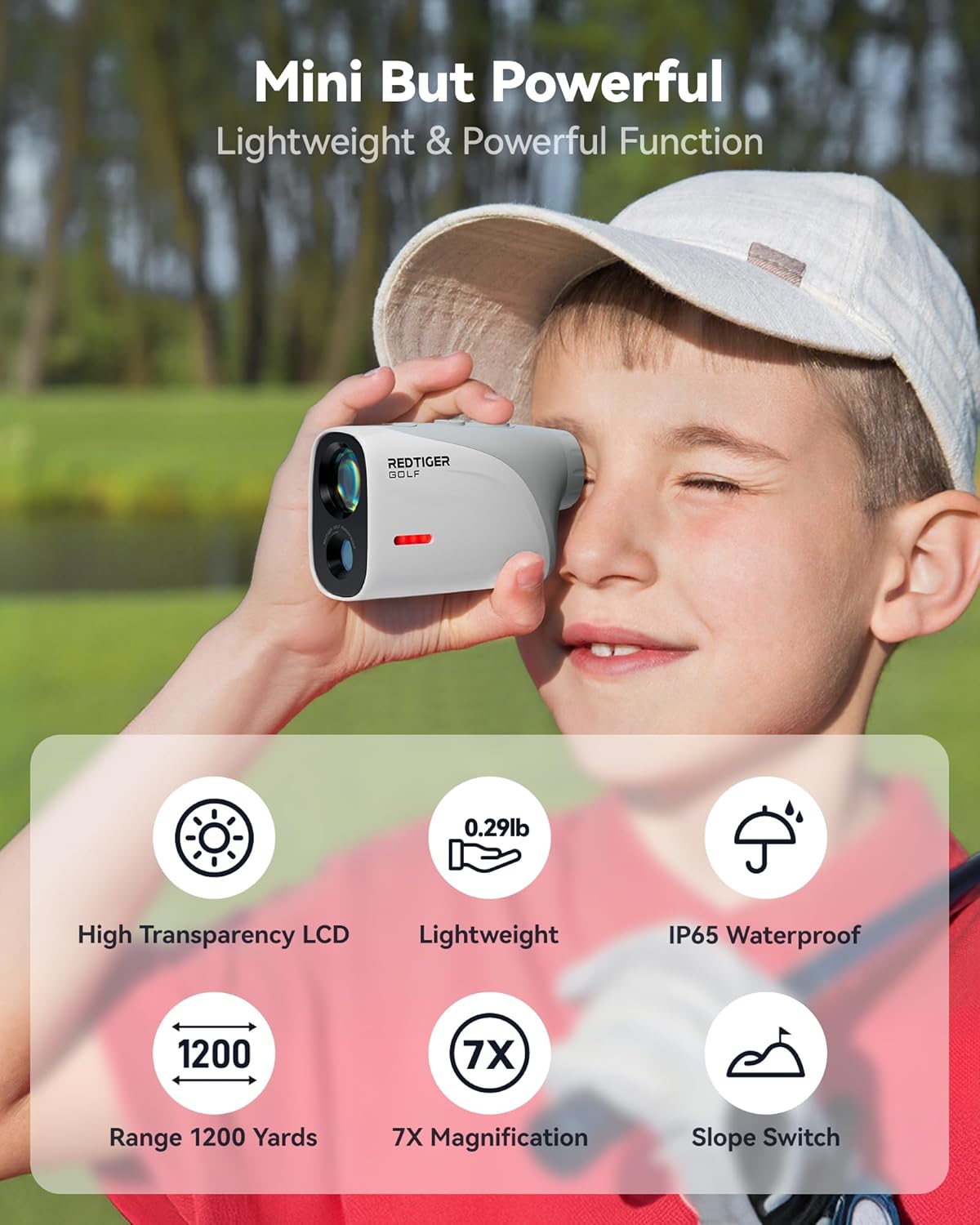
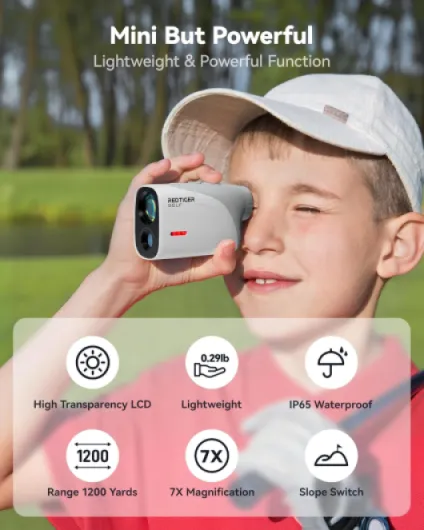
The main thing about this rangefinder is its size. At roughly 9.1 x 3.8 x 5.5 cm and about 0.29 lb (around 130 g), it’s genuinely pocketable. I played a couple of holes with it just shoved in my trouser pocket and it didn’t feel annoying or heavy. Compared to older, bulkier models I’ve used (Bushnell-style bricks), this feels like half the size. If you like to walk and carry your bag, that matters more than you think.
The white polycarbonate body looks clean but also a bit “plastic” in the hand. It doesn’t feel premium, but it doesn’t feel like it’s going to fall apart either. The plastic has a slightly matte finish, which helps with grip. On a cold, slightly wet morning, it didn’t slip out of my hand, even without a glove. There’s a bit of texture on the sides, but it’s not rubberized like some higher-end units. If you’re really clumsy or tend to drop stuff, I’d be a bit careful, but in normal use it’s fine.
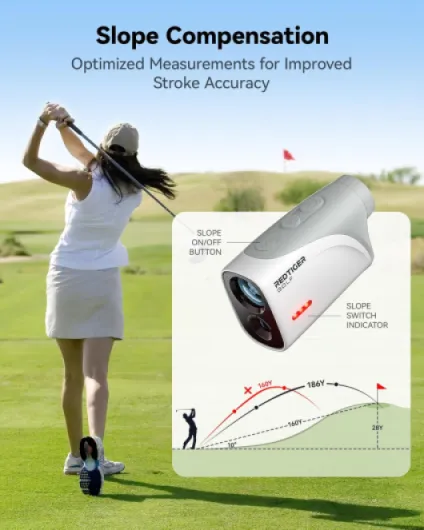
The magnetic side strip is actually pretty useful. I stuck it on the cart frame and on a trolley handle and it stayed put. The magnet feels strong enough that you’re not constantly worried it’ll bounce off on the first bump, but I still wouldn’t trust it on very rough paths for long stretches without checking. The buttons are raised and easy to find with your finger, even without looking: one on top for power/measure, one near it for mode. The slope switch is on the side, and you can clearly see if it’s on or off, which is practical.
Visually, it’s simple: white body, black eyepiece, minimal branding. Nothing flashy. Personally, I liked that. It looks like a tool, not a gadget trying to look fancy. If you’re into super premium finishes, this won’t impress you. But if you just want something compact that doesn’t look silly, the design is pretty well thought out.
Rechargeable battery that you mostly forget about
The battery is one of the reasons I picked this model. It has a built-in 800 mAh lithium-ion battery, charged via USB-C. So no more hunting for CR2 batteries the morning of a round. I fully charged it once before the first use, then used it for three 18-hole rounds and a couple of short practice sessions. By the end of that, it still hadn’t died on me. I didn’t track the exact percentage, but it clearly lasts several rounds without stress.
The brand claims around 14 hours of use. In real life, that sounds about right if you’re not constantly spamming the button. During a normal round, you’re maybe using it 30–50 times, with the device sleeping in between. I never felt any battery anxiety. I just plugged it into the same USB-C charger I use for my phone and watch once every couple of weeks and that’s it. No drama, no weird behaviour, no sudden drops.
One thing I liked: USB-C instead of some random proprietary port. If you forget the cable, you can borrow basically any modern cable. The charging port has a small rubber cover to keep water and dust out. It’s a simple detail, but it matters if you play in the rain or keep the device in a dusty cart. I used it one wet round; no charging issues afterwards, no moisture inside.
If you’re coming from an older rangefinder with disposable batteries, this is a nice upgrade in daily use. The downside is obvious: if the internal battery fails in a few years, you probably can’t just swap it yourself like a CR2. But with a 2-year warranty and the low price point, that’s the trade-off. For now, battery life and convenience are both solid, and I didn’t run into any annoying quirks.
Build quality and weather resistance in real life
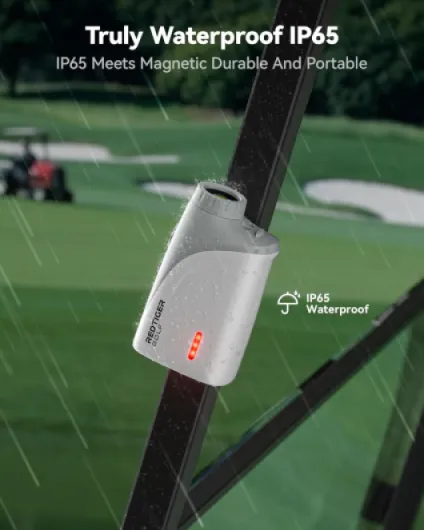
The rangefinder is rated IP65, which basically means dust-tight and able to handle water jets / rain. I didn’t dunk it in a bucket, but I did play in light to moderate rain for a few holes and it kept working fine. No fogging inside the lens, no weird behaviour, no buttons sticking. I just wiped it down with a towel at the end and it looked new again. For typical golf course conditions, that’s enough for me.
The body is polycarbonate, so it’s more “tough plastic” than metal. I didn’t deliberately throw it on the ground, but it did get knocked around in the bag and gently dropped onto the cart path once (from maybe knee height). No cracks, no marks beyond a tiny scuff, and it still works exactly the same. So I’d say it holds up pretty well for normal clumsy use. If you’re someone who constantly drops gear from shoulder height or higher, maybe don’t expect miracles, but for routine use it feels decent.
The lenses stayed clean and didn’t scratch easily, though I kept it in the case most of the time. The case really helps with durability: hard shell, decent padding, and it keeps dust and rain out. I’d strongly recommend actually using the case between shots if you’re walking and slinging your bag around. That’s honestly where a lot of cheaper rangefinders end up getting banged up.
With the 2-year warranty and the brand apparently being responsive (judging by the reviews and the fact that they mention lifetime technical support), I’m reasonably confident it’ll last a few seasons if you’re not abusing it. It doesn’t have the tank-like feel of some premium units, but for a small, light device at this price, the durability is perfectly acceptable and better than I expected.
Accuracy and speed on the course
On to the important bit: does it actually give good distances? In short, yes, for normal golf use it does a good job. I tested it mainly between 50 and 220 yards on flags, trees, bunkers, and some random targets on the range. Most readings came back in about 1–2 seconds. When it locks onto the flag, it gives a little vibration and shows the distance clearly on the screen. Compared to a friend’s more expensive Bushnell, we were usually within 1 yard of each other, sometimes exactly the same number.
The 7x magnification helps. You can clearly see the flag from 150–200 yards without struggling. The optics are not luxury-grade, but they’re bright enough and sharp enough. The internal display is a black LCD overlay. Red would be easier to read in very low light, but for normal daylight rounds, I didn’t have any real visibility issues. The brand talks about 80% light transmission, and honestly, I never felt like the image was too dark, even under clouds.
Flag lock works most of the time, but not 100%. If there are trees or a busy background right behind the green, it can sometimes grab the background instead of the flag. When that happens, the distance usually jumps by 10–20 yards, which is your clue that it’s wrong. A quick trick that worked for me: start aiming slightly to the side of the flag and sweep across. You’ll feel the vibration when it hits the closer object (the flag). Once I did that, I got much more consistent readings.
Range-wise, I did point it at a big building and some trees far away just to see. It happily spat out numbers at 300–400+ yards. I’m not going to pretend I checked 1200 yards exactly, but for golf distances, it’s more than enough. Overall, performance is pretty solid: fast enough, accurate enough, and reliable enough for regular players. Not flawless, but clearly usable and better than guessing or using phone apps alone.
What you actually get in the box
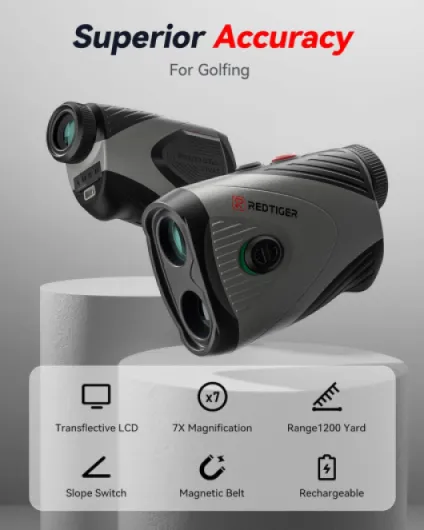
Out of the box, the REDTIGER Mini looks pretty straightforward. You get the rangefinder itself, a hard-shell carry case, a magnetic belt strap, a USB-C charging cable, and a little manual that’s fairly clear. No nonsense, no useless extras. The model I used is the white version, 7x magnification, rated up to 1200 yards with ±0.5-yard accuracy on paper. Realistically, on a golf course, you’re mostly going to use it inside 250 yards, and it handles that without any drama.
The carry case is actually pretty solid. It’s got a zipper plus an elastic strap so you can just flip it open quickly without zipping every time. I clipped it to my bag and didn’t baby it at all — tossed the bag in the car, dragged it across the car park, left it on a damp tee box. The case took the abuse and the device stayed clean and dry. The magnetic belt strap is more of a nice extra: you can stick the rangefinder to a metal part on the cart. I tried it on a buggy and it held on well over bumps, so no complaints there.
Using it is simple: there are basically two main buttons. One for power/measure, one for switching modes (slope on/off, meters/yards). Long press to scan, short press to just zap a target. There’s also a physical slope switch on the side so you can turn slope off for competitions. That’s handy because you can see at a glance if it’s legal for tournaments instead of buried in some menu.
Overall, the “package” is pretty solid: rechargeable battery, proper case, magnetic strap, clear buttons, and readable manual. Nothing fancy, but everything you actually need is there and it all works. No feeling that they cheaped out on the accessories, which is often the case at this price.
Pros
- Very compact and light, genuinely pocketable and easy to carry
- Rechargeable USB-C battery with enough life for several rounds
- Good accuracy and fast flag lock with vibration for the price
Cons
- Plastic build and optics feel less premium than higher-end brands
- Can occasionally lock onto background objects in busy scenes
Conclusion
Editor's rating
After a few rounds with the REDTIGER Mini Golf Range Finder, my overall opinion is pretty straightforward: it’s a compact, practical tool that does what most golfers need without costing a fortune. The distances are consistent, the flag lock with vibration works well most of the time, and the 7x magnification is more than enough to clearly see the flag from normal approach distances. The rechargeable USB-C battery is a real plus compared to older models with disposable batteries, and the small size makes it easy to carry and actually use on every hole.
It’s not perfect. The plastic build doesn’t feel premium, and in tricky backgrounds it can still occasionally lock onto the wrong target, just like many budget and mid-range rangefinders. The optics are good but not fancy, and if you’re very demanding or play at a very high level, you might prefer a higher-end brand. But for the price, the mix of accuracy, portability, IP65 water resistance, and included accessories (case, magnetic strap, slope switch) is hard to argue with.
If you’re a casual to regular golfer who wants to stop guessing distances and doesn’t want to drop big money on a flagship model, this is a solid option. If you already own a high-end Bushnell or similar, this will feel like a step down in feel and maybe in consistency in very tough conditions. In short: great fit for budget-conscious players and mid-handicappers, less interesting if you’re chasing top-tier optics and brand prestige.