
Summary
Editor's rating
Value: good putter, but not a miracle for the price
Design: the black and white actually does something
Comfort and feel: soft, stable, but maybe too muted for some
Materials and build: feels solid, not fancy
Durability: should hold up fine if you use the headcover
Performance on the greens: where it actually helps and where it doesn’t
What you actually get with this Versa Three T
Pros
- Versa black/white alignment makes it much easier to square the face
- Compact mallet head is stable on mishits without being huge
- Soft White Hot insert is forgiving and pleasant on off-center strikes
Cons
- Soft, muted feel may lack feedback for players who like a firm, clicky face
- Head is on the heavier side and takes a couple of rounds to adjust to
- Price is mid-to-high range, not ideal if you already own a similar Odyssey

Specifications
View full product page →| Brand | Callaway |
A mallet for people who actually miss putts
I’ve been gaming the Odyssey Callaway White Hot Versa Three T (33 inch, steel shaft) for a few weeks now, on both slow municipal greens and faster private ones. I bought it because my old blade putter was all over the place on short putts, and I wanted something more stable without going into spaceship-looking putters. This one looked like a good middle ground: mallet head, classic White Hot insert, and the Versa alignment with the black/white contrast.
Right away, the main thing that stood out is how easy it is to aim compared to a plain blade. The black and white pattern on the head actually helps more than I expected. When the face is even slightly open or closed, you see it right away. On three‑footers, that’s honestly where I noticed the biggest difference: I didn’t feel like I was guessing my face angle anymore.
That said, it’s not perfect. If you’re used to a very light blade, the head on this one will feel heavier and a bit “dead” at first. I needed about three rounds to stop leaving putts short because I was babying the stroke. Also, the sound and feel of the insert are quite soft; if you like a clicky, firm feel, this won’t give you that. It’s more of a muted “thud.”
Overall, it’s a pretty solid choice for average golfers who want more forgiveness and help with alignment. It’s not magic: you still have to make a decent stroke. But if you’re the type who pulls or pushes short putts and struggles to set the face square at address, this putter clearly helps. For me, the big win is that my bad putts are a bit less bad, and that already makes rounds less frustrating.
Value: good putter, but not a miracle for the price
In terms of value for money, this Odyssey White Hot Versa Three T sits in the mid-to-upper price range for putters. You’re clearly paying for the brand, the White Hot insert, and the Versa alignment concept. It’s not cheap, but it’s also not as expensive as some fully milled boutique putters or the latest high-end models. For what you get — a solid, forgiving mallet with proven tech — I’d say the value is good, but not insane.
Compared to cheaper, no-name mallet putters I’ve tried, the difference is noticeable: better finish, more stable feel, and a more consistent roll. The White Hot insert also inspires a bit more confidence because you know it’s been used on tour for years. On the other hand, if you already own a recent Odyssey or a similar mallet, the jump to this model may not justify the full price unless you really want the Versa alignment or the specific Three T shape.
Where it earns points is that it actually helps average golfers: alignment is clearer, mishits are less punishing, and the feel is friendly. If you regularly lose strokes on short putts and have been playing with an old, basic putter, this can realistically save you a few strokes per round once you get used to it. That, in my opinion, is worth spending a bit more than on a bargain-bin club, as long as you’re playing often enough.
If your budget is tight, you can probably find used Odyssey Versa or White Hot models for less money and get 80–90% of the same performance. But if you want something new, with current specs, and you like this head shape, the price is fair. Not a steal, not a rip-off. Just a solid purchase for someone who takes their putting seriously but doesn’t expect miracles from equipment alone.
Design: the black and white actually does something
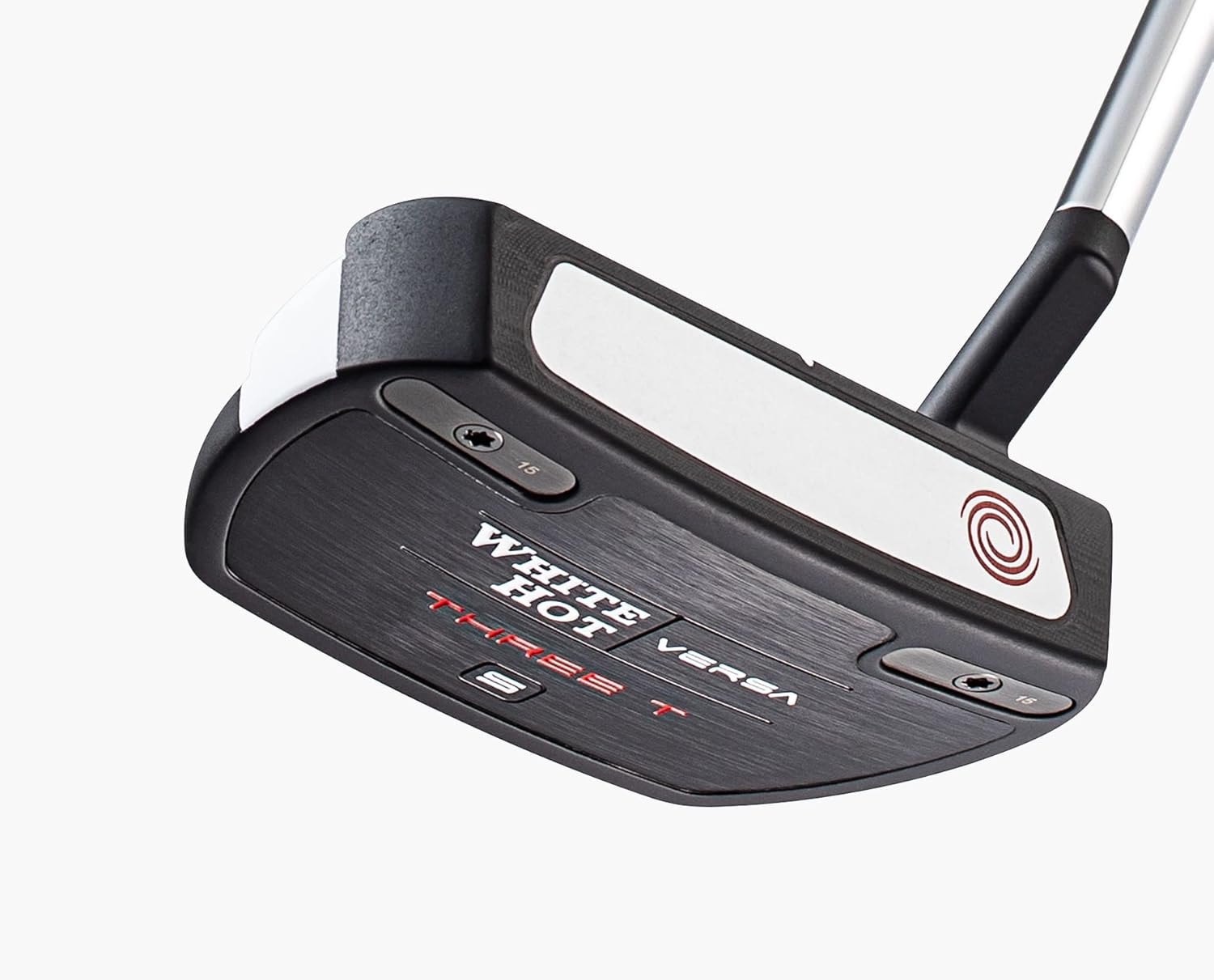
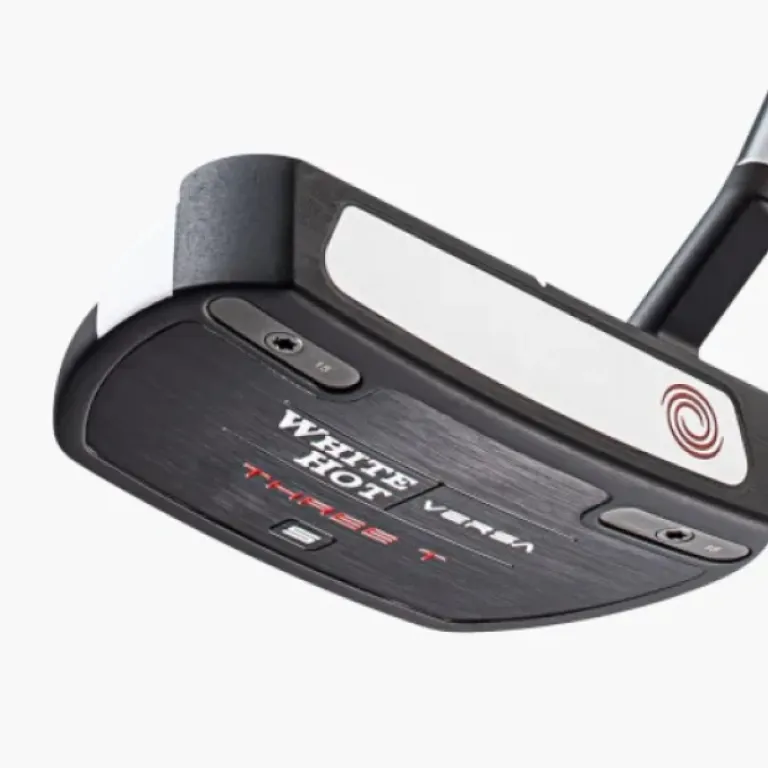
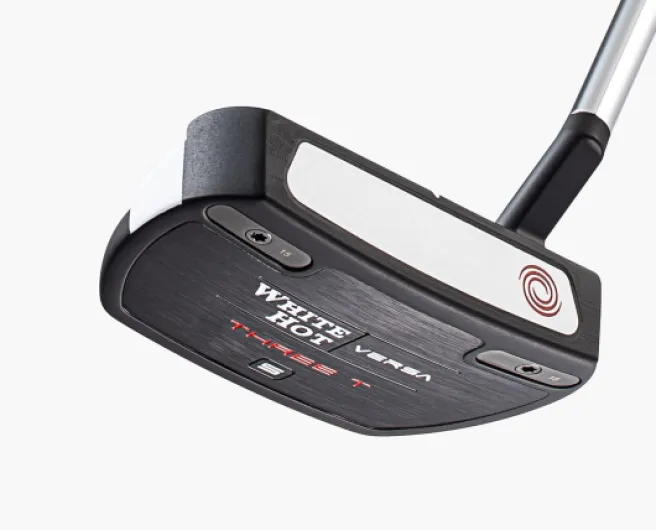
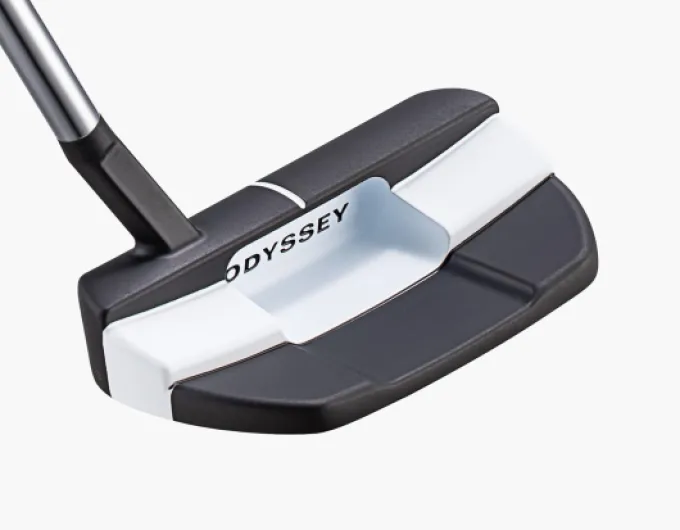
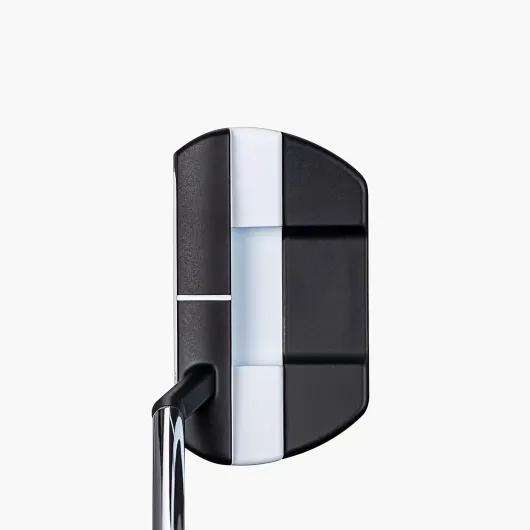
Design-wise, this putter is all about the Versa alignment. The head is mostly black with a wide white stripe running through the center, and that contrast is what helps you square the face. Compared to my old plain stainless blade, the difference is clear: you see the face angle instantly. When I set up on a 2–3 meter putt, I can tell if I’ve got the putter slightly open just from how the black/white lines look relative to my target line.
The head shape itself is a compact mallet. It’s bigger than a typical Anser-style blade but smaller than something like an Odyssey 2-Ball or a big spider-type putter. For me, that’s a good compromise: I get the forgiveness and alignment of a mallet, without feeling like I’m swinging a frying pan. The short slant neck also gives it a cleaner look at address, with not too much metal between your eyes and the ball.
One thing I liked is that the top line and the alignment zones are clear but not overloaded. Some putters throw lines and circles everywhere and end up more confusing than helpful. Here it’s simple: white stripe in the middle, black edges, and that’s it. After a couple of rounds, my routine became pretty automatic: set the white zone on the target line, check the face is square, pull the trigger.
On the downside, if you’re into very traditional looks, this is not it. The black-and-white pattern is quite visible and a bit "modern". Also, in very bright sun, the contrast is strong and can feel a bit busy for players who prefer totally plain heads. Personally, I got used to it quickly, and I’d say the design is more about function than style. It’s not flashy, but it clearly helps with alignment, and that’s what matters for a putter.
Comfort and feel: soft, stable, but maybe too muted for some
In terms of comfort in the hands, this putter is easy to live with. The 33-inch version suits players who like to bend more over the ball and keep their eyes close to the line. I’m around 1m72, and 33 inches felt natural; my arms hung nicely, and I didn’t feel cramped or too upright. If you’re taller or like a more upright stance, you might want the 34-inch version instead.
The head weight is on the heavier side compared to a classic blade, which I actually liked. It gives a smooth, pendulum-like stroke and reduces hand action. On short putts, that extra stability is reassuring. However, if you’re used to very light putters, you might initially feel like you’re fighting the weight or leaving putts short because you’re not swinging freely. After about two rounds, my body adjusted and the weight felt normal.
The pistol grip is standard sized and comfortable enough. It fills the hands without being bulky. I didn’t have any hotspots or discomfort, even after long practice sessions on the putting green. The surface has a decent amount of tack, so I never felt like I was losing grip, even on hot days. That said, if you like very thick grips to reduce wrist action, you’ll probably swap it out, which is pretty common with any putter anyway.
The overall feel at impact is soft and muted. You get a dull “tock” rather than a sharp “click”. That’s pleasant on the ears and hands, especially on hard balls, but it also means the feedback is less precise. You know when you completely mishit it, but small differences in strike aren’t as obvious as with a firm metal face. Personally, I don’t mind that; I care more about forgiveness than ultra-detailed feedback. But if you’re a feel purist, this might bother you a bit.
Materials and build: feels solid, not fancy
The head uses stainless steel with an aluminum sole plate and two 10 g weights, plus the well-known White Hot insert in the face. In hand, it feels solid and well put together. There’s no rattling, no weird vibrations, and the transition between the insert and the rest of the face is clean. The steel shaft is Odyssey’s standard, nothing exotic like carbon or multi-material. It’s a straight steel shaft that does its job.
The White Hot insert is the key material piece here. It’s a soft polymer that gives that muted feel. On center hits, it feels smooth and forgiving. On slight mishits toward the toe or heel, you lose a bit of energy, but not a ton. I noticed that my distance control stayed acceptable even when I didn’t strike it perfectly. Compared to a full-milled steel face I tried before, this insert definitely hides small mistakes better, but you also lose some of the crisp feedback.
The grip is the Odyssey Pistol Black/Red, about 76 g. It’s a normal-sized putter grip, not an oversized one. The rubber feels decent, with enough tack even when hands are a bit sweaty. After a few rounds, I didn’t see any signs of premature wear or peeling. If you’re a fan of fat grips, you’ll probably swap it out, but out of the box it’s fine for most people.
Overall, the materials feel like mid-to-high range, not cheap. It’s assembled in China/Japan, and it feels consistent with other Odyssey gear I’ve used. Nothing here screams luxury, but nothing feels flimsy either. For a putter in this category, I’d say the build quality is pretty solid, and I’d be surprised if it aged badly with normal use and a headcover.
Durability: should hold up fine if you use the headcover
On the durability side, after several weeks of use and a bunch of rounds, the putter still looks almost new. The black finish on the head hasn’t chipped, and the white alignment zone hasn’t turned ugly or yellow. Obviously, I use the included headcover between shots, which helps a lot. If you just throw it in the bag without protection, expect the black paint to pick up dings and scratches over time, like any painted putter.
The White Hot insert is well seated and doesn’t show any separation or lifting. I’ve had older Odyssey models where the insert aged well for years, so I’m not worried here. The steel shaft is standard and robust; no rust or marks so far, but I also dry my clubs after rainy rounds. The grip is holding up well too, with no signs of early wear, cracking, or loss of tackiness after several practice sessions and some sweaty summer days.
The headcover itself is decent. It’s not luxury, but it protects the head and the closure stays put. The stitching hasn’t come apart, and the material doesn’t look like it will fall apart quickly. Again, nothing fancy, but it does what it’s supposed to do. If you’re picky about covers, you might buy a nicer one, but you don’t have to.
Overall, I’d say durability is pretty solid for a mainstream putter. As long as you treat it like a normal golf club (headcover on, don’t bang it on the cart path, don’t leave it soaking wet in the trunk), it should last years without any real problem. It doesn’t feel fragile at all, and the materials and finish seem well chosen for regular use.
Performance on the greens: where it actually helps and where it doesn’t
On the course, the main thing this putter brings is forgiveness and alignment help, not crazy distance control miracles. For short putts (inside 2 meters), my make percentage clearly went up compared to my old blade. A lot of that is simply because it’s easier to aim and the head doesn’t twist as much on slight mishits. Even when I caught it slightly toward the toe, the ball still started close to my intended line instead of shooting off to the side.
For medium and long putts, the head weight and insert give a smooth, stable stroke, but you do need a bit of time to dial in distance. The soft insert means you have to hit it a bit firmer than with a firm-faced putter, especially on slower greens. My first two rounds, I left a lot of putts short because I underestimated how much energy the insert eats. Once I got used to it, distance control became consistent, but it’s not as “instant feedback” as a milled steel face.
In terms of stroke type, the short slant neck gives it some toe hang, so it suits a slight arc stroke better than a straight-back-straight-through motion. With my slight arc, the putter felt natural, and I didn’t feel like I had to manipulate the face. If you’re very straight-back, you might prefer a face-balanced mallet instead. I also noticed that on off-center hits, the head stayed pretty stable; you lose a bit of distance but the ball direction remains decent, which is exactly what most mid-handicap players need.
Overall, performance is good, reliable, and predictable once you get used to the feel. It won’t suddenly turn you into a putting wizard, but it cleans up the worst misses and makes your average stroke more stable. For me, that’s about all I realistically expect from a putter. If you already putt very well with a blade, this won’t suddenly give you five strokes per round. But if you struggle with face control and mishits, you’ll probably see a real benefit.
What you actually get with this Versa Three T
This model is the White Hot Versa Three T, 33-inch, short slant, right-handed, with a steel shaft. It’s a mallet type, but not one of those huge, super high-MOI heads. It’s more compact, a bit like a halfway point between a classic blade and a full-size mallet. Loft is 3 degrees, lie 70 degrees, which is pretty standard for putters. Out of the box, you get the putter, a headcover, and the Odyssey pistol grip in black and red.
The head construction is stainless steel with an aluminum sole plate and two sole weights (around 10 g each). That’s what gives it the slightly heavier head feel. The face has the classic White Hot insert, which Odyssey has been using for years. If you’ve hit other White Hot putters, this will feel very familiar: soft, a bit muted, and quite forgiving on mishits. The length I tested is 33 inches, which suits players around 1m70 or shorter who like to bend more over the ball. Taller players might prefer the 34-inch version.
On the course, the presentation is pretty straightforward: this is built for stability and alignment, not for showing off in the bag. The short slant neck means there’s some toe hang, so it suits a slight arc stroke better than a dead-straight back-and-through motion. If you’re used to a face-balanced mallet, you’ll feel that difference. For me, with a small natural arc, the putter sat nicely and didn’t feel like it was fighting my stroke.
In short, the product is exactly what the spec sheet says: a compact mallet with a soft insert and a focus on alignment. No fancy adjustability, no hidden tech you’ll never use. It’s a simple tool that tries to make aiming and starting the ball on line easier, and that’s how it behaves in real rounds.
Pros
- Versa black/white alignment makes it much easier to square the face
- Compact mallet head is stable on mishits without being huge
- Soft White Hot insert is forgiving and pleasant on off-center strikes
Cons
- Soft, muted feel may lack feedback for players who like a firm, clicky face
- Head is on the heavier side and takes a couple of rounds to adjust to
- Price is mid-to-high range, not ideal if you already own a similar Odyssey
Conclusion
Editor's rating
The Odyssey Callaway White Hot Versa Three T 33-inch is a solid, forgiving mallet for golfers who want help with alignment and face stability without going to a huge, bulky head. The black-and-white Versa design actually works: you see if the face is square or not, and that alone can clean up a lot of short-putt misses. The White Hot insert gives a soft, muted feel that’s easy on the hands and ears, and the head weight makes the stroke smoother and more stable than a light blade.
It’s not flawless. The feel is quite soft, so if you like sharp feedback and a clicky sound, you might find it too muted. Distance control on long putts takes a bit of adjustment because the insert absorbs some energy, especially on slow greens. And the price is not low, so if you already putt well or own a recent Odyssey, the upgrade might not be life-changing.
I’d recommend this putter to mid-handicap and casual golfers who struggle with alignment and mishits, and who want a compact mallet with a proven insert. If you’re a traditionalist who loves thin blades, firm milled faces, and super simple looks, you’ll probably be happier elsewhere. But if you’re honest with yourself and know that your putting could use more forgiveness and clearer aiming, this Versa Three T is a very reasonable and practical option.