
Summary
Editor's rating
Value for money: where it sits versus the big brands and cheap copies
Design and ergonomics: light, compact, a bit plasticky but practical
Battery life and everyday use: will it last a few rounds?
Build quality and durability: light but not fragile
Performance on the course: speed, accuracy, and Buddy mode in real use
What you actually get in the box and how it feels in hand
Pros
- Fast and consistent distance readings with clear pin-lock vibration
- Lightweight and compact, easy to carry or clip to bag/cart with magnet
- Useful Buddy/triangulation mode for sharing distances and blind shots
Cons
- Plastic build feels less premium than higher-end brands
- Only IPX4 water resistance, better to avoid heavy rain
- Uses CR2 batteries instead of convenient USB charging

Specifications
View full product page →| Brand | GolfBuddy |
A compact rangefinder that’s more than just point-and-shoot
I’ve been using the GolfBuddy GB LASER 2S Pro for a few rounds now, and I’ll be straight: I picked it mainly because of the price, the Buddy mode, and the fact it’s lighter than a lot of the big brands. I’m not sponsored, I paid for it myself, and I’ve previously used a Bushnell and a couple of cheap Amazon specials, so I’ve got a decent comparison point.
On the course, the first thing that stood out is how small and light it feels. At 161 g with the battery, it doesn’t drag your bag down, and you don’t really notice it on your belt or hanging off the bag. It’s not the kind of device you baby or worry about; you just grab it, shoot, and shove it back in the case or onto the magnet clip.
The second thing is the speed. GolfBuddy claims 0.15 seconds to get a reading. I obviously didn’t time it with a stopwatch, but in practice you press, you get a number almost instantly. There’s no long laser dance on the flag unless your hands are really shaky or the pin is miles away with no background contrast.
It’s not perfect: the plastic build feels more mid-range than premium, the slope toggle could be a bit more obvious, and the optics, while clear, are not on the same level as the top-end Bushnell I used before. But overall, for the money, it’s a pretty solid tool that genuinely helps with club selection and pace of play, especially if your group doesn’t all have rangefinders.
Value for money: where it sits versus the big brands and cheap copies
On value, this sits in a nice middle ground. It’s not as cheap as the random no-name rangefinders you see on Amazon, but it’s also nowhere near the price of the top-end Bushnell or Garmin units. For what you get – fast measurements, slope, pin vibration, Buddy/triangulation mode, a case, magnet clip, and a two-year warranty – I’d say the price is fair. You’re paying for a known golf brand and some extra features, but not paying silly money for a logo.
Compared to the cheaper units I’ve tried, the GB LASER 2S Pro feels more reliable. The readings are more consistent, and I had fewer moments where I wasn’t sure if it had locked onto the flag or the trees behind. The vibration lock and the speed of the reading make a real difference to how confident you feel picking a club. The Buddy mode is also something I haven’t seen done this cleanly on many budget models; it’s actually usable and not just a bullet point.
Compared to premium brands like Bushnell, you do sacrifice a bit: the build doesn’t feel as solid, the optics are slightly less sharp, and you don’t get the same brand prestige. But in terms of actual shots saved or confidence gained, I don’t think the average mid-handicap golfer is losing much by choosing this instead of something twice the price. If you mainly care about reliable distances and a light device, this gives you most of what matters.
So, value-wise, I’d sum it up like this: if you want a solid, practical rangefinder that does all the essentials well and throws in a genuinely useful Buddy mode without costing premium money, this is a good deal. If you’re obsessed with top-tier optics or want a more rugged, metal-feeling device, you might feel it’s a bit basic. For most regular golfers who just want to stop guessing yardages, it hits a sensible balance between price and performance.
Design and ergonomics: light, compact, a bit plasticky but practical
The design is pretty straightforward: black plastic body, rounded edges, nothing flashy. It’s clearly designed to be functional more than pretty, which I actually prefer on something that’s going to get chucked in and out of a golf bag. The main thing that stood out for me is the weight and size. At about 161 g and under 10 cm long, it’s very easy to handle with one hand, even when you’re standing on a slope or in the rough.
The grip is okay. There’s a bit of texture on the body, but it’s not super grippy rubber like some premium brands. In dry weather it’s totally fine. In light rain or with sweaty hands, it can feel a bit slick, but not to the point of being unusable. It’s rated IPX4 water resistant, so it can handle a light shower or some splashes, but I wouldn’t leave it exposed in a heavy downpour. I played nine holes in drizzle with it, and it kept working without issues, but I did keep it in the case between shots.
Button placement is decent: the main power/measure button is right where your index finger lands, and the mode button is behind it. You don’t really need to look at the top once you know which is which. The vibration when you lock on the pin is clear enough to feel, but not so strong that it shakes your aim. The eyepiece focus ring turns smoothly and stays in place once set. I wear contact lenses and had no trouble getting a clear image; a mate with glasses also managed fine by just adjusting the focus.
The magnet clip is a nice touch. I ended up clipping the magnetic plate to the side of my bag, and the rangefinder sticks to it firmly enough that it didn’t fall off even on bumpy buggy rides. If your trolley or cart has a metal frame, you can stick it straight on there too. Just be aware it’s not the strongest magnet on earth, so I wouldn’t trust it over big bumps if it’s hanging somewhere totally exposed. Overall, the design is practical and golfer-focused, but it does feel more like a tool than a premium toy.
Battery life and everyday use: will it last a few rounds?
The GolfBuddy GB LASER 2S Pro uses a CR2 lithium battery, which is pretty standard for rangefinders. One battery is included in the box, so you can start using it right away. I’ve used it for several rounds plus a couple of practice sessions on the range, and the battery is still going strong. There’s no detailed battery percentage indicator, but you do get a basic low-battery warning in the display when it starts to run down.
Based on my use and what I’ve seen with similar devices, you’re probably looking at several dozen rounds on a single CR2, depending on how often you laser things like trees, bunkers, and layup spots. It’s not something you’re charging every week like a GPS watch. For me, this is both good and bad: good because you don’t have to remember to charge it; a bit annoying because when the CR2 finally dies, you need to have a spare or you’re stuck. Personally, I just keep a spare CR2 in my bag now – they’re small and cheap enough.
There’s an auto shutoff function that turns the unit off after a short period of inactivity. On the course, this is actually helpful. You pull it out, ping a couple of targets, then if you forget to turn it off, it’ll handle itself. I didn’t notice any real lag when waking it back up; you just press the button and it’s ready to go. Over a four-hour round, you’re not burning through the battery just because you forgot to press power.
Overall, I’d say the battery situation is practical but old-school. If you love USB-C charging and tracking everything, you might find it a bit dated. If you prefer a simple device that just works for months on a single battery, you’ll be fine. Just do yourself a favor and buy a spare CR2 and leave it in your golf bag so you’re not caught out mid-round.
Build quality and durability: light but not fragile
Durability was one of my concerns when I saw the weight and the plastic build. After a handful of rounds and some slightly careless treatment, I’m reasonably confident it can handle normal golf abuse. I’ve dropped it once from about waist height onto grass and once onto the cart path from the bag; in both cases, it came away with only a small cosmetic mark on the corner and kept working just fine. The plastic doesn’t feel premium, but it doesn’t feel like it’ll crack at the first knock either.
The IPX4 water resistance rating means it’s splash-resistant, not fully waterproof. I’ve used it in light rain and wet conditions with no issues. The lens stayed clear enough with a quick wipe from the microfiber cloth, and no fogging inside the unit. I wouldn’t want to stand in a full-on downpour lasering flags for 18 holes, but in typical mixed British weather, it’s holding up. The case helps too – it’s stiff enough to protect it from most bumps in the bag.
The buttons still have a good click after repeated use, and the focus ring hasn’t loosened up or drifted. The magnet plate also hasn’t peeled or shifted, which is something I’ve seen happen on cheaper magnetic mounts. The carrying case zip works fine and the elastic quick-access strap hasn’t stretched out yet. Small details, but these are the things that start to annoy you after a season if they’re badly made.
That said, it’s not built like a tank. If you’re the type who throws clubs and bags around or leaves gear rolling around in the trunk without the case, you’ll eventually mark it up. Also, because it’s so light, it doesn’t have that reassuring solid feel of metal-bodied units. For the price point, I’d call the durability decent: it stands up to normal golfing life, but I wouldn’t treat it like an indestructible tool. The two-year manufacturer warranty is a bit of extra reassurance if something internal fails.
Performance on the course: speed, accuracy, and Buddy mode in real use
In terms of raw performance, this thing is pretty solid. The claimed range is up to 1093 yards, and while I don’t have a 1,000-yard target on my course, I had no problem picking up flags at 180–230 yards and trees or bunkers well beyond that. The 6x magnification is enough to see the flag clearly, even on longer par 5s. The unit locks onto flags quickly; most of the time I got a reading in under a second, and the vibration confirmed it had locked on.
Accuracy-wise, I compared it side by side with a friend’s Bushnell on a few holes. Distances were usually within 1 yard of each other, sometimes exactly the same. For normal amateur golf, that’s more than accurate enough. I also checked it against course markers (150 and 100 yard plates, plus a couple of sprinkler heads) and it lined up very closely. I didn’t see any weird jumps or inconsistent readings unless I was trying to shoot through branches or had a flag with no background behind it on a very bright day.
The slope function works as expected. You get the actual distance plus the slope-adjusted number. On my home course, there are a few holes where you’re hitting quite a bit uphill or downhill, and the adjusted distance mostly matched what I’ve learned by feel over time. It’s not magic, but it’s helpful, especially on unfamiliar courses. Just remember to turn slope off if you’re playing in competitions where it’s not allowed; the toggle is straightforward, but it’s on you to check.
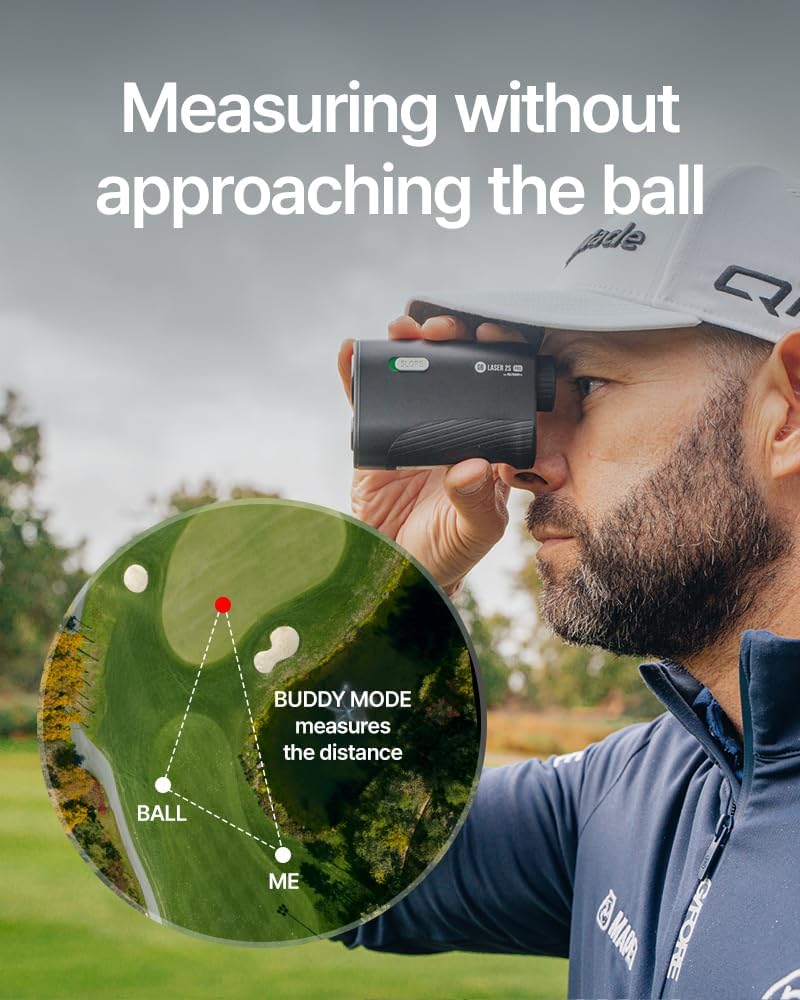
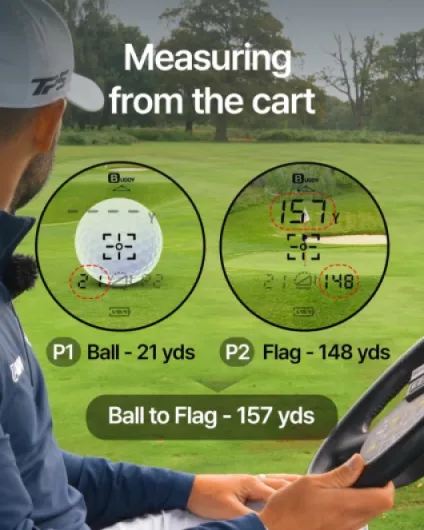
The standout for me is the Buddy/triangulation mode. In practice, here’s how it works: you stand at your ball, laser your friend’s ball, then laser the pin. It gives the distance from their ball to the pin, not just yours. This was genuinely handy when a mate was on the opposite side of the fairway without a device, or on blind shots where you can’t see the flag from your ball. It’s not something you use on every shot, but when you need it, it’s actually useful rather than a gimmick. Overall, performance is reliable, quick, and consistent for normal golf use.
What you actually get in the box and how it feels in hand
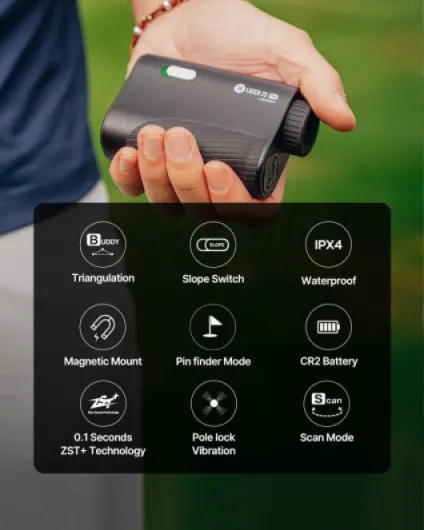
Out of the box, the GolfBuddy GB LASER 2S Pro looks like a straightforward, no-nonsense rangefinder. You get the unit itself, a CR2 battery, a hard carrying case, a magnet clip, a small carabiner, a microfiber cloth, and a quick start guide. So in terms of accessories, you’re covered for normal golf use without needing to buy extras. The case is the standard zip-and-bungee style you see on lots of rangefinders, nothing fancy but it does the job.
The unit is small: about 9.9 x 6.5 x 3.6 cm. In hand, it feels compact, so if you’ve got smaller hands you’ll probably like it. It’s also very light at around 161 g with the battery, which is noticeably lighter than my old Bushnell. That’s nice if you clip it to your belt or cart, because it doesn’t swing around or drag. The trade-off is that you don’t get that heavy, premium, metal feel – it’s clearly plastic, but the assembly feels decent and not flimsy.
Controls are simple: you’ve basically got the power/measure button and a mode button. No crazy menus, no app pairing, nothing overcomplicated. The viewfinder has 6x magnification, which is standard and enough for normal golf distances. Inside, you can switch between yards and meters and turn slope on or off. The readings show up clearly with slope-adjusted distance when that mode is active, plus the straight line distance. There’s also the pin finder with vibration, and the Buddy/triangulation mode, which I’ll get into later.
Overall, in terms of presentation, it feels like a mid-range, practical product: you get what you need, it’s fairly compact, and it’s ready to use out of the box. It doesn’t try to be fancy or high-tech beyond what’s actually useful on the course. If you’re expecting a luxury gadget, you’ll be a bit underwhelmed; if you just want something that works and is easy to throw in the bag, it hits the mark.
Pros
- Fast and consistent distance readings with clear pin-lock vibration
- Lightweight and compact, easy to carry or clip to bag/cart with magnet
- Useful Buddy/triangulation mode for sharing distances and blind shots
Cons
- Plastic build feels less premium than higher-end brands
- Only IPX4 water resistance, better to avoid heavy rain
- Uses CR2 batteries instead of convenient USB charging
Conclusion
Editor's rating
The GolfBuddy GB LASER 2S Pro is a straightforward, reliable golf rangefinder that focuses on doing the basics well and adds a couple of genuinely helpful extras. It’s light, compact, quick to lock onto flags, and the distances line up closely with more expensive brands I’ve tested alongside it. The slope feature and pin-lock vibration work as expected, and the Buddy/triangulation mode is more than just a gimmick if you often play with partners who don’t have their own device or on courses with blind shots.
It’s not perfect. The plastic build feels mid-range rather than premium, the optics are good but not top-tier, and the IPX4 rating means it’s fine in light rain but not something I’d abuse in a storm. You also rely on CR2 batteries instead of USB charging, so it’s worth keeping a spare in your bag. But in day-to-day use, none of these are deal-breakers; they’re just trade-offs for the price point and low weight.
I’d recommend this to mid- and high-handicap golfers who want a dependable rangefinder without paying top-brand prices, and to anyone who values light weight and simple controls over fancy extras. If you’re a gear snob who wants the most premium feel and the sharpest optics, or you regularly play in harsh weather and want something more rugged, you might be happier spending more on a higher-end model. For most club golfers, though, this is a pretty solid balance of performance, features, and cost.