Summary
Analysis score
Average of the criteria rated below
Value: niche accessory with average feedback and no clear edge
Design focused on lightness and targeted lumbar placement
Comfort: light and unobtrusive for some, awkward for others
Breathable, lightweight build but limited information on fabric quality
On-course performance: light swing cue rather than a full support solution
What this golf lower back belt is supposed to do
Effectiveness: support and swing help that vary widely by user
Pros
- Lightweight and breathable design (0.21 kg) suitable for long practice sessions
- Targets the L5 lumbar area and hips, which are key zones for golf swing stability
- Some buyers report noticeable lower back support and improved swing awareness
Cons
- Several reviews say it offers very little real support, similar to a normal belt
- Effectiveness is inconsistent and highly dependent on user expectations and body type
- Average 3.0/5 rating and low category ranking, with no clear edge over competitors

Specifications
View full product page →| Brand | G GAIARENA |
A golf back belt that divides opinion
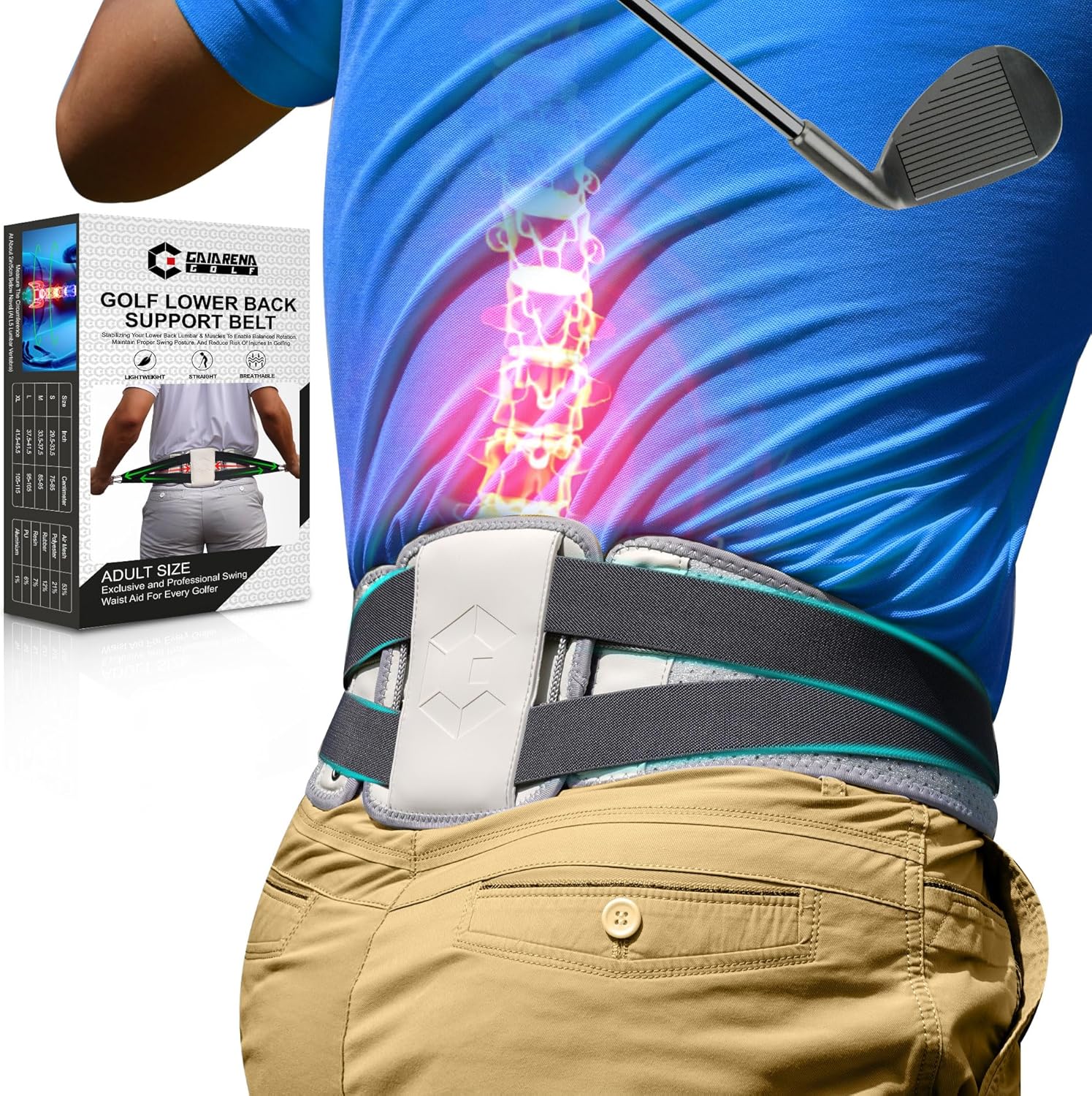
The GAIARENA Golf Lower Back Support Belt targets a very specific niche: golfers who practice often and want extra support around the lower back and hips. On paper, it promises to tighten the waist and hip area, protect the lumbar region, and help players feel their rotation better during the swing. It sits roughly at the L5 lumbar vertebra, about 5 cm below the belly button, according to the sizing instructions. With a weight of 0.21 kg and compact dimensions, it clearly aims to be a light, easy-to-carry training accessory rather than a heavy-duty medical brace.
Looking at the public feedback, reactions are clearly mixed. The average rating hovers around 3.0 out of 5 stars from just over a dozen reviews, which is neither a disaster nor a clear success. Some buyers call it basically useless for support, while others say it offers decent help for lower back discomfort and swing stability. This split suggests that expectations, body types, and maybe even swing styles play a big role in how people perceive it.
The brand positions this belt as both a protection tool and a training aid. The idea is simple: by stabilizing the lower back and hips, golfers should feel their rotation path more clearly and gradually build a more balanced, powerful swing. For players who are already cautious about back pain, that pitch is attractive. But the comments from verified purchases show that the level of support is not consistent for everyone.
In my opinion, the product sits somewhere between a light training cue and a modest support belt, not a medical-grade brace. If someone expects rigid, orthopedic-style reinforcement, they may be disappointed. If the goal is a light, breathable belt that adds a bit of awareness to hip and waist movement, the concept makes more sense. The rest of the analysis looks at where it seems to deliver and where it falls short, based on the specs and what golfers report.
Value: niche accessory with average feedback and no clear edge
Evaluating value here means balancing what the GAIARENA belt promises against its real-world reception and its niche. It sits in the golf swing trainer category, where there are many gadgets: alignment sticks, weighted clubs, resistance bands, and various belts. With a Best Sellers Rank around #333,340 in Sports & Outdoors and #911 in Golf Swing Trainers, it is clearly not among the most popular options. The average rating of 3.0 out of 5 from 13 reviews also places it in a middle ground: not a flop, but far from a crowd favorite.
On the plus side, the belt is light, compact, and specialized. It targets golfers who practice regularly and want something that can both support the lower back and help refine their swing. For someone who already spends money on lessons, range balls, and other training tools, adding a small belt that might reduce discomfort and improve awareness can make sense, especially if the price remains moderate. The breathable, skin-friendly materials and the focus on L5 placement show that some thought went into design, even if the brand is not a big golf name.
On the downside, the inconsistent effectiveness reported in reviews hurts perceived value. When a product is called “basically worthless” by some and “works well” by others, it becomes a gamble. Golfers with serious back issues might be better served by a more established medical support brand or by consulting a professional for a tailored brace. Similarly, players mainly interested in swing improvement might find better value in more widely praised training aids. Without a clear, widely recognized advantage in support, comfort, or performance, GAIARENA’s belt ends up as an option that may or may not be worth it depending on your specific needs.
In my opinion, the belt offers decent but not standout value. It could be a reasonable purchase for golfers who want to experiment with a light lumbar support/swing cue and are aware that results are not guaranteed. But it’s hard to recommend it as the first choice when the feedback is so split and the product does not dominate its category. If the price is low, the risk is acceptable; if it is close to more proven supports, then the value proposition becomes weaker.
Design focused on lightness and targeted lumbar placement
The design of the GAIARENA Golf Lower Back Support Belt is quite straightforward: a compact, lightweight belt that wraps around the lower torso, specifically targeting the L5 lumbar region. Its dimensions (about 10.63 x 4.72 x 1.38 inches for the item, and a slightly larger package) show that this is not a big, bulky brace. Instead, it looks more like a slim support band that can be slipped into a golf bag pocket without taking much room. The low weight of 0.21 kg reinforces this impression of minimal bulk.
The description emphasizes an adjustable design, which suggests some type of hook-and-loop or similar fastener to tighten the belt around the waist and hips. One review explicitly mentions that the belt can be adjusted for a snug fit and is comfortable for longer periods. On the other hand, a very negative review says it is “impossible to get tight enough to do any level of support”. That contrast hints that either the adjustment range is limited for certain body shapes, or the closing system lacks the firmness some users expect from a support belt.
The brand also insists on the exact placement: users are instructed to measure around 2 inches below the belly button, where the L5 vertebra is located. Design-wise, this means the belt is meant to sit quite low on the torso, crossing both the lower back and the top of the hips. In theory, that should help stabilize not only the spine but also the pelvic region, which is key in golf swing rotation. For a swing training accessory, that targeted placement makes sense and sets it apart from generic waist trimmers or fitness belts that sit higher or are designed mainly for sweating.
Visually and structurally, nothing in the available information suggests any rigid stays, metal inserts, or complex orthopedic structure. In my opinion, this confirms the idea that GAIARENA chose a flexible, sport-oriented design rather than a medical-grade support frame. That choice explains why some golfers feel it as a light aid, while others, who might expect something stiffer, feel let down. Design-wise, it’s more of a training belt with support ambitions than a full-on back brace.
Comfort: light and unobtrusive for some, awkward for others
Comfort is one of the areas where opinions diverge, but the overall picture leans toward a light and generally bearable belt rather than something intrusive. One review explicitly notes that the belt feels strange at first, but after about 30 minutes the wearer forgets it’s there, which is a good sign for long practice sessions. Another positive comment mentions that the item looks good and is “very nice”, which, while vague, suggests no immediate red flags regarding how it feels to wear.
The product description claims the materials are breathable and skin-friendly, designed so golfers can wear it for a few hours comfortably. That aligns with the low weight (0.21 kg) and the compact design, both of which should reduce bulk under clothing. For golfers who walk a full 18 holes or spend time on the range, a thin, light belt is usually preferable to a thick, heavily padded brace. If the wearer indeed forgets about it after some time, that indicates that mobility is not heavily restricted and that there are no major pressure points causing discomfort during the swing.
However, comfort is not only about softness; it also involves how secure the belt feels. The most negative reviews say the belt cannot be tightened enough to provide real support, comparing it to a typical belt rather than a true support product. While this is mainly a criticism of effectiveness, it also affects perceived comfort. If someone is constantly adjusting or pulling on the belt to get more compression, that can become annoying and distract from the game. In addition, if the belt rides up or down due to insufficient grip, it can create a sensation of instability rather than comfortable snugness.
In my opinion, golfers who prioritize freedom of movement and lightness will likely find the comfort acceptable, especially if they do not expect a super-tight, rigid feeling. Those who want a very firm hug around the waist and hips may find the belt both under-supportive and awkward, since it doesn’t fully match that expectation. Comfort here is closely tied to expectations: as a soft, breathable training accessory, it seems to do the job for some. As a tight, medical-style brace, it will probably feel like a compromise that doesn’t deliver the secure, locked-in sensation some back pain sufferers are looking for.

Breathable, lightweight build but limited information on fabric quality
The manufacturer highlights three main points about the materials: they are skin-friendly, breathable, and lightweight. This is consistent with a product intended for use on the golf course, where players can spend several hours walking and swinging in varying temperatures. A heavy or non-breathable belt would quickly become annoying, so the decision to prioritize light fabric makes sense. With a weight of just 0.21 kg, the belt is clearly on the lighter side compared with many orthopedic supports or powerlifting belts.
However, the exact composition of the materials is not detailed. There is no mention of neoprene, nylon, polyester blend, or any specific fabric technology. This lack of precision makes it hard to judge the long-term resistance to sweat, stretching, or repeated fastening. For a product worn directly on the skin or over thin clothing, details about elasticity and durability would be useful. Right now, buyers have to trust the generic promise of being skin-friendly and breathable, without knowing much about how it behaves after dozens of uses or washes.
Among the published reviews, there are no strong complaints about itching, rashes, or obvious material defects. Some users praise the comfort and say it can be worn for extended practice without major discomfort. That indirectly supports the idea that the fabric is at least reasonably gentle on the skin and not overly stiff. On the flip side, one of the main criticisms – the feeling that the belt does not provide enough support – may be related to the softness or stretchiness of the material. If the fabric is too flexible, even a tight closure may not create the firm brace-like sensation some golfers expect.
In my opinion, the materials are probably adequate for a light training accessory, but might be underwhelming for those who want a robust, semi-rigid back support. The emphasis on breathability and low weight is a plus for comfort and mobility, but this direction often means compromising on stiffness. Without clearer information on fabric composition and reinforcement, it’s safer to view this belt as a soft, sports-style support rather than a heavy-duty protective device built for maximum rigidity or long-term wear-and-tear resistance.
On-course performance: light swing cue rather than a full support solution
From a performance standpoint, the GAIARENA belt is positioned as both a swing training aid and a lower back support. The manufacturer claims that by stabilizing and tightening the hips and waist, golfers can feel their rotation more clearly, leading to a more balanced and powerful swing over time. Some reviews back up this idea indirectly. One user notes that it definitely helps with lower back pain and suggests using it at the driving range first, implying that it can change the feel of the swing and may require an adaptation phase before a competitive round.
Another positive review highlights that the belt adds stability during swings and helps reduce pressure on the lumbar area. It mentions that the belt can help distribute forces more evenly and protect muscles and joints during long practice sessions. For players who hit a lot of balls, that kind of consistent, moderate support can be valuable, even if it doesn’t feel like a rigid brace. In that context, the belt plays more of a preventive and educational role: it encourages a more controlled movement pattern and reminds the player to rotate correctly rather than sway or over-extend the lower back.
However, negative comments underline that performance is closely tied to the level of support. If a golfer cannot get the belt tight enough or feels no real compression, the product becomes little more than a regular belt, with almost zero impact on swing mechanics or pain reduction. This explains the low-end ratings from some buyers. For them, there is no noticeable difference in swing balance or power, and the belt doesn’t justify its place in the bag. That gap between satisfied and disappointed users shows that the belt’s performance is not universally reliable.
In my opinion, this product behaves more like a light swing cue with mild support than a high-performance medical or pro-grade training device. It can help certain golfers, especially those with moderate issues and realistic expectations, to become more aware of their hip and waist movement. But it does not seem to fundamentally change performance for everyone, and it certainly won’t fix deep swing flaws or serious back pathology. As a complement to proper technique work with a coach, it may have a role. As a standalone solution for back pain or swing inconsistency, it looks limited.

What this golf lower back belt is supposed to do
GAIARENA presents this belt as a dual-purpose product: a support tool for the lower back and hips, and a technical aid for improving golf swing mechanics. It is designed to be worn around the area of the L5 vertebra, roughly 2 inches below the belly button. The manufacturer insists on the measurement point, which shows they want people to size it correctly so the belt actually sits at the intended lumbar region. The size listed here is Medium, but the concept clearly implies multiple sizes exist, so picking the right one is crucial.
According to the description, the belt is made from breathable and lightweight materials, with a focus on being skin-friendly. The idea is that golfers can wear it for several hours on the course or at the driving range without feeling like they’re carrying extra weight. At 0.21 kg (about 210 grams), it is indeed quite light, closer to a sports brace than any heavy support system. The compact product and package dimensions also suggest easy storage in a golf bag pocket.
The promised benefits are threefold. First, support and tightening of the lower back and hips to reduce muscle soreness and protect against musculoskeletal issues. Second, improved swing awareness: with the area stabilized, golfers are supposed to feel hip and waist rotation more clearly. Third, injury prevention for frequent players, especially those who practice long sessions where repetitive swinging can stress the lumbar region. The product is clearly targeted at enthusiasts and beginners who play or practice regularly, rather than occasional once-a-month golfers.
In my opinion, this positioning is coherent: it’s not marketed as medical equipment, but as a sports accessory with a support angle. However, the relatively low Amazon ranking in golf swing trainers (#911) and the 3/5 average rating indicate it has not become a reference product in this category. For golfers, that means it should probably be considered as one option among many training aids and belts, not a guaranteed solution for all back issues or technique problems.
Effectiveness: support and swing help that vary widely by user
Effectiveness is clearly the most debated point for the GAIARENA Golf Lower Back Support Belt. On one end, a very harsh 1-star review describes the belt as “basically worthless” and “impossible to get tight enough to do any level of support”. Another 1-star comment says it offers no more support than a typical belt, despite being true to size. These users clearly expected firm, brace-like reinforcement and felt they got almost none. For them, the belt fails its main promise of support and protection for the lower back.
On the other side, there are reviews that give the product 3 to 5 stars and mention tangible benefits. One user reports that it “works well and gives support to your lower back”, although they also say it feels weird at first and can potentially throw off your game if you don’t get used to it at the driving range before a real round. Another more detailed review says the belt provides enhanced support for the swing, helps stabilize the waist and hips, reduces pressure on the lower back, and can help prevent musculoskeletal damage during long practice sessions. That same comment notes that the support may be limited in some cases but still considers it helpful for regular practice.
The product description itself sets expectations of improved swing balance and strength by tightening and stabilizing the lower back and hips. According to the positive feedback, some golfers do feel more stability and better awareness of hip rotation, which is exactly what a swing trainer with support goals should do. The belt is also described as distributing forces more evenly and reducing the risk of muscle strains and joint pressure over time, which seems coherent with a light compression belt that encourages more controlled movement.
In my opinion, the mixed feedback indicates that this belt is effective mainly as a moderate support and awareness tool, not a cure-all for back pain. Golfers who have mild discomfort and want a bit of extra stability may find it useful, especially if they give themselves some time to adapt at the range. Those with significant lower back issues or those expecting strong, rigid support similar to medical braces or powerlifting belts are likely to be underwhelmed. The advertised benefits are reachable for some users, but the inconsistency in reviews shows that body shape, expectations, and severity of back problems heavily influence perceived effectiveness.
Pros
- Lightweight and breathable design (0.21 kg) suitable for long practice sessions
- Targets the L5 lumbar area and hips, which are key zones for golf swing stability
- Some buyers report noticeable lower back support and improved swing awareness
Cons
- Several reviews say it offers very little real support, similar to a normal belt
- Effectiveness is inconsistent and highly dependent on user expectations and body type
- Average 3.0/5 rating and low category ranking, with no clear edge over competitors
Conclusion
Analysis score
The GAIARENA Golf Lower Back Support Belt is a light, niche accessory that tries to sit between a sports brace and a swing training aid. It aims to stabilize the lower back and hips, reduce strain, and help golfers feel their rotation better. Some reviews say it delivers moderate support and noticeable relief, especially when used regularly during practice. Others find it almost useless, with little to no real compression compared with a normal belt. That split makes it a risky pick if someone expects strong, medical-style reinforcement.
In my opinion, this belt makes the most sense for golfers who have mild discomfort, want a bit of extra stability, and are curious about using a belt as a swing awareness tool. These players are likely to appreciate the low weight, breathable materials, and relatively unobtrusive design. However, golfers with significant back problems, or those wanting rigid support, should look toward more specialized braces or consult a professional. Similarly, players focused purely on swing improvement might get more reliable results from better-established training aids.
Overall, this is a product with a coherent concept but uneven execution. It can help some golfers, but it is far from a guaranteed fix. If the price is attractive and your expectations are modest – light support, some extra awareness of hip movement – it could be worth a try. If you want strong, consistent support backed by a lot of positive feedback, this belt is probably not the best candidate.