Summary
Analysis score
Average of the criteria rated below
Value for money: one club versus a full travel set
Design focused on portability and versatility
Feel, feedback, and the steel vs graphite dilemma
Steel shaft, mixed head materials, and what that implies
Durability and travel-readiness
On-paper performance and what golfers report
What the Q Gen 2 Adjustable Golf Club actually offers
Pros
- 8 adjustable loft settings from 4° to 60°, covering putter-style to lob wedge roles
- Two-part stainless steel travel shaft and compact package size make it easy to pack and carry
- 3-year manufacturer warranty and buyer feedback pointing to solid construction and durability
Cons
- Steel shaft version can deliver rough feedback in the hands according to the published review
- Right-handed only and regular flex only, which excludes many golfers
- Single-club concept trades precise yardage gapping and traditional feel for convenience

Specifications
View full product page →| Brand | Q Golf |
A single club that claims to cover your whole short set
The Q Gen 2 Adjustable Golf Club aims straight at golfers who travel or hate lugging a full set around. On paper, it’s a compact solution: one head with 8 loft settings, from a 4° putter-style setting all the way up to a 60° lob wedge, matched to a two-part steel shaft that breaks down for easy transport. The idea is simple: instead of paying baggage fees or renting random clubs, you carry this one stick in a small bag or suitcase and still get a reasonable range of shots.
The spec sheet is pretty clear about the target: men and women, right-handed only, regular flex, unisex-adult. This is not a full-bag replacement for serious competition, but more a flexible tool for practice, casual rounds, or hitting balls whenever you get the chance on the road. The Amazon ranking (#48 in Complete Golf Club Sets) shows it’s positioned like a compact set alternative, even if it’s just one adjustable club.
Public feedback is still limited: there is a single published review with a 4/5 rating. That buyer highlights strong distance potential and solid construction, while also pointing out some rough feedback in the hands and a regret about not choosing the graphite shaft version. With so few comments, it’s hard to draw broad conclusions, but at least there’s one detailed opinion from a verified purchase to cross-check with the specs.
In my opinion, the concept is interesting: 8 lofts, a travel-friendly shaft, and a 3-year manufacturer warranty suggest a brand that expects the club to be used, not just admired. It’s not going to replace a custom-fitted set for serious players, but for someone who just wants to swing a real club on the road without a big bag, it looks like a practical, if somewhat niche, option.
Value for money: one club versus a full travel set
The price is not displayed here, but the value proposition of the Q Gen 2 is easy to understand: instead of buying or carrying several clubs for travel, you buy one adjustable club with 8 loft settings. If a golfer typically checks a bag or rents clubs on trips, saving on baggage fees and rental costs could offset the purchase over time. The Amazon category ranking (#48 in Complete Golf Club Sets) shows it’s being considered as an alternative to budget sets rather than as a premium specialty club. The inclusion of a carry bag and protective sleeve adds a bit of value since you don’t need to buy extra storage accessories.
The single public review gives it 4/5 and a “B+ grade” for the steel shaft version, which indicates that the buyer feels it performs reasonably well for what it is. Their main regret is not ordering the graphite shaft version, which suggests that within the Q Gen 2 lineup, there may be a comfort or performance difference that some golfers are willing to pay extra for. Unfortunately, with the graphite version sold out in that account, it’s hard to directly compare value between the two. Still, it hints that demand is strong enough to deplete stock on the seemingly more comfortable option.
Compared with a full travel bag of 6–8 clubs, this single-club approach clearly saves space and logistical hassle. The trade-off is precision and traditional feel: you don’t get perfectly spaced yardage gaps or dedicated clubs for every situation. For many casual players or travelers, though, that compromise is acceptable if it means they can swing a real club wherever they go without overpacking. The 3-year warranty also matters for value; if the club lasts through many trips and practice sessions, the cost per round or per range visit becomes quite reasonable.
In my opinion, the Q Gen 2 steel version offers decent value for golfers who actually travel frequently and will use the portability advantage. For someone who rarely flies or who already owns a compact half-set, the value is less clear. This is a specialist product: high value for a specific use case, but not necessarily the smartest spend for a golfer who mostly plays at their home course with a full bag already in the trunk.

Design focused on portability and versatility
The design logic of the Q Gen 2 is pretty straightforward: take the footprint of a single club, then make it behave like several. The head offers 8 loft positions from 4° to 60°, which covers a very wide spectrum of shot types. The adjustment system is not fully described in the spec sheet, but the mention of “360 Degrees” and “adjustable 8-loft head” suggests a rotating or indexed mechanism around the hosel. In practice, that should allow quick changes between iron-like and wedge-like settings without tools beyond whatever locking system is built in.
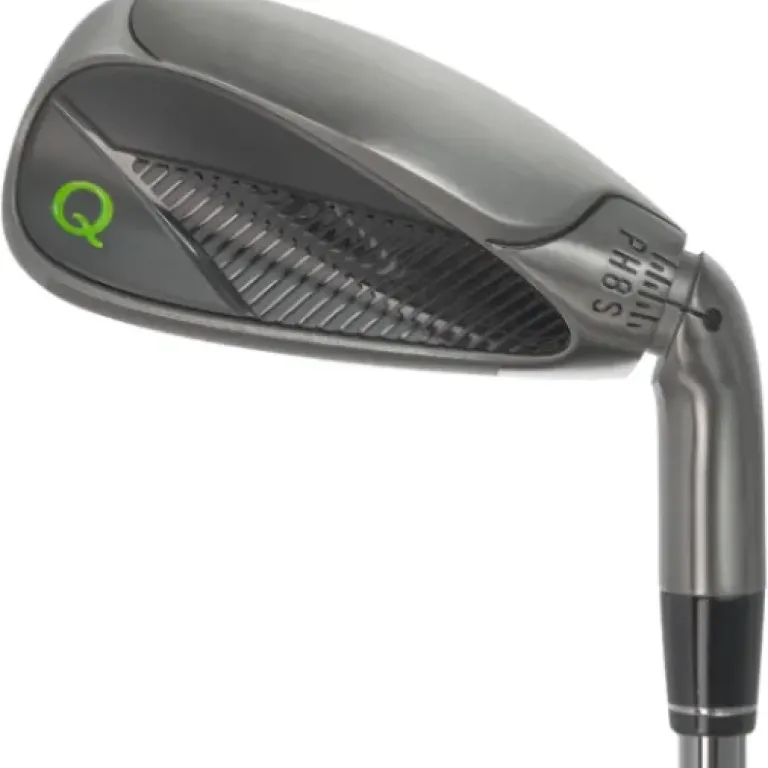
Visually, the color scheme is black and silver, which is standard and discreet. There’s no clutter of bright colors or oversized logos mentioned, so this likely looks like a conventional modern club with an unusual hosel. The three-position extra-long grip is an important part of the design: instead of just one hand placement, golfers get multiple reference zones along the grip. That can help adjust effective club length or fine-tune control for different shots. On paper, this is a smart move for a multi-role club, since a 4° setting and a 60° setting are normally played with different shaft lengths and postures.
The shaft being a two-part “DuraLock” travel design shapes the overall look and feel. You have a joint in the shaft where conventional clubs are a single piece. Some golfers might be wary of that, but the one published review explicitly mentions “well constructed, no concerns with durability.” That comment suggests that, at least for that buyer, the joint and locking mechanism did not feel flimsy. Still, the existence of a visible joint is part of the aesthetic and may not appeal to purists who want a clean, uninterrupted shaft.
In my opinion, the design is clearly function-first. Every unusual element—the long grip, the adjustable head, the two-part shaft—serves the goal of making one club do many jobs and fit in small luggage. It’s not about classic looks or traditional bag composition. If someone wants a conventional set with matching irons and wedges, this is the opposite direction. But for a golfer who values convenience and versatility, the design choices look coherent and fairly thought-through.
Feel, feedback, and the steel vs graphite dilemma
Comfort with a golf club is mostly about weight, balance, grip, and how much vibration reaches your hands. Here, the only detailed comment from buyers is that the steel shaft version gives “definite feedback in the hands” and that this can feel rough if the club is not held correctly. That same reviewer explains that after a few hits they figured out the grip that worked for them, implying that initial comfort might be mixed but improves with minor adjustments in hand placement or pressure. The three-position extra-long grip is likely involved here, offering multiple zones where the hands can rest.
Steel shafts are generally heavier and transmit more vibration than graphite. On this club, with a two-part shaft and an adjustable head, that probably means a fairly honest feel: mishits are more noticeable, and pure strikes feel distinct. For some players, that sort of feedback is valuable because it clearly signals when they’ve made a good or bad swing. Others, especially those with elbow or wrist issues, might prefer a softer-feeling graphite version that absorbs more shock. The single reviewer actually regrets not having ordered the graphite shaft model and notes that it was sold out, which suggests there is demand from golfers who prioritize comfort and feel over maximum sturdiness.
The long grip design is interesting for comfort. Being able to slide the hands up or down can help find a position that reduces strain or better matches the golfer’s height and swing style. Someone shorter might naturally grip lower, effectively shortening the club and making it easier to control. Someone taller or with a more aggressive swing might choose a higher position for leverage. While no reviews go into that level of detail, the concept fits how many players already choke up or down on regular clubs for control.
In my opinion, the comfort profile of the steel Q Gen 2 is best suited to golfers who don’t mind a firmer, more direct feel and who are willing to tinker a bit with grip placement. Players looking for a very soft, muted sensation or those with sensitive joints may want to wait for the graphite version or consider similar products with more vibration-damping designs. As it stands, the feedback in the hands is both a strength and a potential downside, depending on what the golfer expects.

Steel shaft, mixed head materials, and what that implies
The Q Gen 2 steel version uses a stainless steel shaft with regular flex, combined with a head made from a mix of plastic, stainless steel, and titanium. Stainless steel is a standard material for many irons and shafts because it is relatively strong, resistant to corrosion, and cost-effective. For a travel club that might be tossed in bags, rental cars, and hotel rooms, corrosion resistance and impact resilience are especially important. The titanium element in the head likely contributes to strength-to-weight ratio, allowing the brand to keep the head weight within a playable range despite the added complexity of an adjustable mechanism.
The presence of plastic in the material list usually points to trim pieces, adjustment collars, or cosmetic housings. In an adjustable club, plastic parts are often used around the hosel or in the locking system for weight savings. This is normal in the industry, but the durability of those parts depends heavily on execution. There are no specific complaints about breakage or cracked components in the lone review, and that buyer actually praises the construction quality and expresses no durability concerns, even with a fast swing speed.
Compared with graphite, a stainless steel shaft tends to be heavier and can transmit more vibration. That lines up with the single review mentioning “definite feedback in the hands” and describing it as “rough feedback” if the grip isn’t held right. That comment can be interpreted as the steel shaft and grip combo giving a fairly direct feel when contact is off. For some players, that’s a positive because it clearly tells them when they’ve mishit; for others, especially those with joint sensitivity, it might feel harsh.
In my opinion, the material choices look sensible for a travel-oriented, adjustable club that needs to survive repeated assembly and disassembly. Steel and titanium give it the backbone, while plastic likely keeps weight manageable and allows for a practical adjustment mechanism. The main trade-off is feel: steel with multiple joints and moving parts won’t be as muted as a well-damped graphite design. Anyone particularly sensitive to vibration or who strongly prefers lighter shafts might lean toward the graphite version when it’s available, which is exactly what the single reviewer wished they had done.
Durability and travel-readiness
Durability is a critical point for an adjustable travel club. The Q Gen 2 steel version leans on its “DuraLock” two-part shaft and a head built from stainless steel and titanium, backed by a 3-year manufacturer warranty. That warranty period is relatively generous for a niche club, and it indicates that Q Golf expects the locking mechanisms and materials to hold up under real use, including frequent assembly and disassembly for travel. Stainless steel is known for good fatigue resistance and corrosion protection, which is important when the club might be exposed to humidity, temperature changes, and rough handling in luggage.
The public review from a verified buyer specifically mentions that the club feels well constructed, with no concerns about durability, even with a fast swing speed. That’s encouraging because fast swingers tend to put more stress on the shaft and hosel, especially during mishits or from hitting off less-than-ideal surfaces. While this is just one data point, it helps counter the natural skepticism some golfers have about two-part shafts and adjustable heads being weak points.
The presence of plastic in the material list could raise questions about long-term wear, especially around the adjustment system. However, without reports of cracks or failures, there’s no concrete evidence pointing to a weak spot so far. The relatively low package weight (0.93 kg including accessories) suggests the club is not overbuilt to the point of being cumbersome, yet it is not ultra-light either, which might be a reasonable middle ground between robustness and portability.
In my opinion, on paper, the Q Gen 2 steel version looks solid enough for its intended use: travel, practice, and casual golf. It is unlikely to be as bulletproof as a single-piece forged iron, but that’s not the mission. For someone who packs and unpacks golf gear often, the combination of a metal shaft, metal core head, and a multi-year warranty is reassuring. The real long-term verdict will depend on how the adjustment mechanism handles repeated changes over months and years, but nothing in the current specs or reviews suggests an obvious red flag.

On-paper performance and what golfers report
In terms of performance, there is one main data point from the public review: a golfer with a fast swing, who normally averages 170+ yards with a regular 6-iron (steel shaft), reports hitting the 6-iron setting on the Q Gen 2 to 201 yards once, with about 186 yards carry, and somewhat shorter on other swings. That suggests the club is at least capable of producing distances in the same ballpark as a standard iron, and sometimes more, depending on strike quality and loft setting. Of course, that’s a single user and one standout shot, so it should be seen as an anecdote rather than a universal benchmark.
The adjustable loft range from 4° to 60° theoretically covers a wide variety of shots: low runners, standard approach shots, chips, pitches, and high lobs. Performance in each setting will depend heavily on how consistently the loft mechanism locks in and whether the head weight and shaft balance feel stable across all 8 positions. The 3-position extra-long grip is supposed to help maintain some consistency by letting golfers choke up or down to mimic different club lengths. On paper, this should support more controlled shots at higher lofts and more aggressive swings at lower lofts.
The one reviewer gives the steel shaft version a “B+ grade,” which is a decent endorsement for performance and overall playability. They mention that once they figured out the grip that worked for them, the club produced better results, which hints at a small learning curve. That makes sense: going from a full set, where each club has a fixed length and lie, to a single adjustable club requires some adaptation in stance, ball position, and expectations.
In my opinion, the Q Gen 2 is not aiming to beat a fitted iron set for consistency or precision. Its strength is versatility and portability, with performance that is “good enough” for practice, casual rounds, and travel golf. The early feedback suggests it can deliver solid distance and usable feedback, but golfers who are very picky about exact yardages and gapping may find the compromises of a single adjustable club a bit limiting compared to a full, well-matched set.
What the Q Gen 2 Adjustable Golf Club actually offers
The Q Gen 2 (Steel Shaft) is built around a fairly bold promise: one adjustable club that covers a wide loft range from 4° to 60°. The head has 8 distinct settings, so in theory you can approximate everything from a low-lofted putter or bump-and-run club up through mid irons and into wedge territory. The manufacturer explicitly calls out settings like 6-iron and lob wedge in the marketing, which lines up with the single user review mentioning a 6-iron setting used for a 200+ yard shot. That gives a rough idea of how the loft progression is intended to work in real play.
The shaft is a two-part “DuraLock” travel design made from stainless steel, with a regular flex profile. It breaks down small enough to fit in a compact carry bag with a drawstring, which is included along with a protective sleeve. The package weight is around 0.93 kg, and the box dimensions (roughly 24.7 x 5.3 x 2.8 inches) suggest something that fits easily into a suitcase or overhead bin compared to a full-length single-piece club. Everything is right-hand only, so left-handed golfers are excluded from this model.
Materials are a mix of plastic, stainless steel, and titanium. That combination is typical for adjustable golf heads: metal for the core structure and face, plastic for housings or adjustment mechanisms. The “360 degrees” loft spec is clearly describing the adjustability range around the hosel, not a literal 360° golf loft. The 3-year warranty stands out in this price segment and implies some confidence in the adjustable mechanism and the two-part shaft’s locking system.
In my opinion, the Q Gen 2 is positioned as a compact, versatile club first and a pure performance tool second. It tries to give travelers and casual players enough flexibility to enjoy full rounds or range sessions without needing a trunk full of gear. If someone accepts the trade-offs of an adjustable design and a single club covering many roles, the feature set looks coherent: 8 lofts, regular flex, right-handed, travel shaft, and minimal accessories to keep things simple.
Pros
- 8 adjustable loft settings from 4° to 60°, covering putter-style to lob wedge roles
- Two-part stainless steel travel shaft and compact package size make it easy to pack and carry
- 3-year manufacturer warranty and buyer feedback pointing to solid construction and durability
Cons
- Steel shaft version can deliver rough feedback in the hands according to the published review
- Right-handed only and regular flex only, which excludes many golfers
- Single-club concept trades precise yardage gapping and traditional feel for convenience
Conclusion
Analysis score
The Q Gen 2 Adjustable Golf Club (Steel Shaft) is a practical concept executed in a fairly straightforward way: one adjustable head, 8 loft settings from 4° to 60°, a two-part stainless steel shaft, and a long multi-position grip, all designed to fit easily into travel scenarios. It targets right-handed, regular-flex golfers who want to hit real shots on the road without paying baggage fees or relying on random rental sets. The single detailed review backs up the idea that the club is solidly built, capable of realistic distances, and generally delivers what it promises, while also pointing out noticeable feedback in the hands and a preference for the graphite version.
In my opinion, this is not a replacement for a fitted, full set if you care about exact yardages and traditional feel. It’s a convenience tool: good for business trips, vacations, or casual practice when hauling a whole bag is unrealistic. The steel version leans more toward durability and honest feedback than plush comfort, which will suit some players and turn off others. If you travel often, enjoy tinkering, and are okay with a single club covering many roles, the Q Gen 2 steel model looks like a sensible, if somewhat niche, purchase. If you mostly play one home course, want soft feel, or need left-handed gear, you’re probably better off with a conventional setup or waiting for the graphite variant.