Summary
Analysis score
Average of the criteria rated below
Value for money: small spend, recurring benefit
Compact design focused on speed and clarity
30 mil plastic: built to survive a golf season (or several)
Built to handle bag abuse and regular rounds
What the Rules Caddy 2025 actually offers
How useful is it as a real rules tool on the course?
Pros
- Compact 3" x 5" bag-tag format that’s easy to keep on hand during every round
- Durable 30 mil plastic construction that buyers describe as well made and long-lasting
- Covers common USGA rules with recent updates, presented in a simplified, quick-reference style
Cons
- Limited surface area means it can’t cover every rare or complex rules scenario in depth
- Best suited to players who care about rules; very casual golfers may not use it enough to see the benefit

Specifications
View full product page →| Brand | Caddy Cards |
A pocket “rules official” for real-world rounds
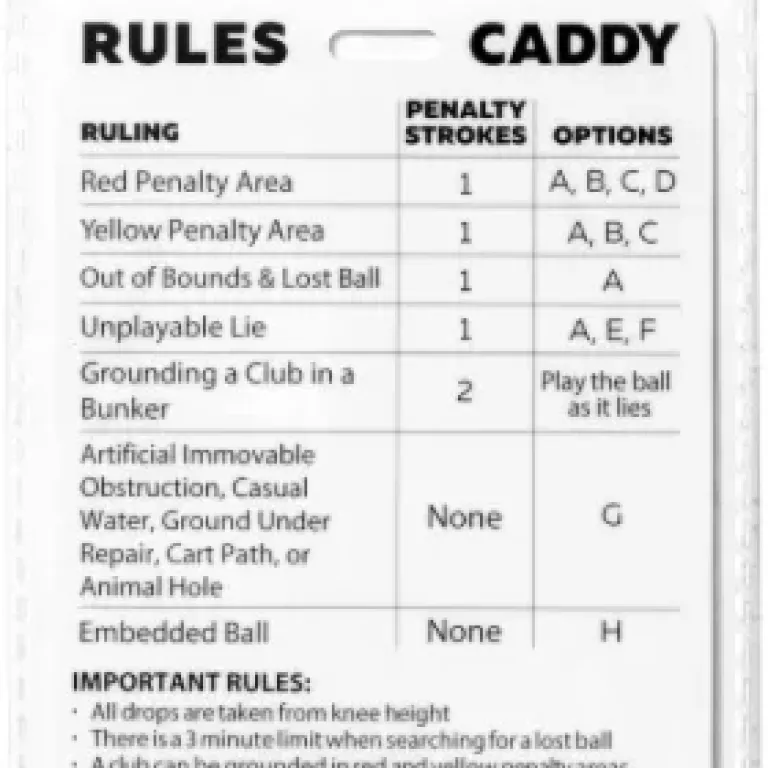
The Rules Caddy 2025 is clearly aimed at a very specific need: having the key USGA Rules of Golf on you, in a format you can actually use mid-round. Instead of carrying the full rule book or trying to scroll through an app, this product goes for a simple 3" x 5" plastic card that hangs on your bag or fits in a pocket. With an average of 4.4/5 from about 150 Amazon ratings, it seems to satisfy most golfers who bought it.
The concept is straightforward: it’s a quick reference guide that condenses the most common rules situations into short, usable explanations. The manufacturer highlights that it includes the major USGA rule updates up through 2025, which matters for players in leagues, club events, or tournaments where outdated rules can cost strokes or create arguments.
Several short reviews describe it with phrases like “easy to use,” “good summary of rules,” and “rules at your fingertips.” That gives a clear picture of the promise: not to replace the full rule book, but to give you just enough information to make a reasonable decision quickly when you’re standing over a ball in a tricky situation.
In my opinion, the interest of this product is not raw technology or innovation, but its practical format, durability, and clarity. If the content is well structured and the print holds up in real golf conditions, it’s the kind of small accessory that quietly solves a recurring headache: nobody remembering the correct drop or penalty on the spot.
Value for money: small spend, recurring benefit
The exact price isn’t listed here, but products in this category are usually in the low-cost accessory range. For that type of budget, you’re getting a 30 mil plastic rules card with up-to-date USGA changes, a bag tag loop, and a design tuned for quick reference. With an average rating of 4.4/5 from around 150 buyers, the satisfaction level is clearly above average for a simple accessory.
Value depends on how often you play and how seriously you take the rules. For someone who plays a couple of casual rounds per year and doesn’t care much about strict compliance, this might feel like a nice-to-have rather than a necessity. But for golfers who play in leagues, club tournaments, or money games, a small tool that reduces rule disputes and wrong drops can easily justify its cost. One wrong ruling can be more frustrating than the price of this card.
Compared to alternatives, you could use the free USGA app or download PDFs, but those require a charged phone, decent signal, and some navigation time. You could carry the full rule book, but many golfers simply don’t. The Rules Caddy positions itself as the middle ground: not exhaustive, but always there, fast, and durable. In my opinion, that trade-off makes sense for a lot of regular players.
Overall, I’d call the value for money good to very good for its target audience. You’re not paying for tech or branding; you’re paying for curated content, durability, and convenience. It’s not a glamorous purchase, but it can quietly improve pace of play and reduce arguments, which is worth quite a bit to many golfers over a season or two.

Compact design focused on speed and clarity
The design is built around one idea: fast access. At 3" x 5", the Rules Caddy fits comfortably in a pocket, yardage book cover, or hangs off your bag as a traditional tag using the included plastic loop. That’s a deliberate choice compared to a small booklet or a folded brochure, which can be slower to navigate and easier to damage. Here, the card format suggests that the rules are organized in short, categorized chunks that you can scan quickly between shots.
The color is listed as white, which likely supports high-contrast printing for better readability. Several reviews underline that it is “easy to read,” which implies a reasonably clear font size and layout, not tiny fine print crammed edge to edge. Since it’s supposed to be used outdoors, possibly in less-than-ideal light, layout decisions (headings, icons, bullet points) matter as much as the actual content. While there are no photos here, the positive comments on readability are a good sign.
The bag tag approach is also interesting from a usability angle. Instead of digging through pockets or the cart, the card can just hang on the side of your bag, always visible and reachable. For golfers who like a clean look, this may or may not fit their aesthetic, but functionally it means one less thing to misplace. And if you prefer, the dimensions make it small enough to move it inside a pocket or a yardage book for a more discreet setup.
In my opinion, the design is practical rather than fancy. There’s nothing high-tech here, but the dimensions, color choice, and bag tag attachment are coherent with the intended use: quick consultation in real playing conditions. For golfers who value speed and simplicity over a full manual, this minimalistic design is a clear strong point.
30 mil plastic: built to survive a golf season (or several)
The Rules Caddy is made from 30 mil plastic, which is roughly the thickness you see in sturdy membership cards or durable ID badges. This is much thicker than simple laminated paper or a flimsy tag. With an item weight around 0.01 kg and a compact surface, it’s light but not paper-thin. On paper, this thickness should give decent resistance to bending, moisture, and abrasion, all of which are common on a golf course.
Buyer comments like “durable and easy to read” and “well made” reinforce the idea that the material choice is not just a marketing bullet. Golf bags get tossed in trunks, dragged through rain, and dropped on cart paths. A thin cardboard or low-quality laminate would likely curl, peel, or fade quickly. Here, the 30 mil plastic suggests a card that can handle repeated handling and exposure without disintegrating.
Another advantage of this material is that print tends to stay legible longer. On many cheap bag tags or laminated cards, the ink can rub off where fingers repeatedly touch the same spots. While there’s no long-term lab data here, the combination of buyer praise on durability and the relatively thick plastic points to a product that should outlast a season of regular play for most golfers, as long as it’s not deliberately abused.
In my opinion, the material choice is one of the main strengths of this product. For a rules reference, longevity matters: you don’t want the card to become unreadable right when you need it in a club championship. The trade-off is that you’re limited to a fixed amount of surface area; you can’t just add more pages. But if the content is well curated, the 30 mil plastic format is a solid compromise between ruggedness and portability.

Built to handle bag abuse and regular rounds
Durability is clearly one of the selling points of the Rules Caddy. The card uses 30 mil plastic, which is in the same ballpark as a tough ID badge or quality membership card. Combined with the tiny weight (0.01 kg) and compact dimensions, this gives a product that should be resistant to bending, splashes, and everyday knocks. On a golf course, that matters more than people sometimes realize: bag tags get hit by clubs, scraped by carts, and soaked by rain.
Among the published reviews, phrases such as “works well, durable and easy to read” and “well made easy to use” keep coming up. While these comments are brief, they consistently point in the same direction: golfers are not seeing the card fall apart quickly. That’s important, because accessories at this price point can sometimes feel disposable; here, the perception is closer to a long-term course companion.
The bag tag design also influences durability indirectly. Since the card can hang outside the bag, it is always visible and less likely to be lost at the bottom of a pocket or wedged under gear in a trunk. Of course, that also exposes it more to sun and weather, but the plastic construction should handle UV and moisture better than paper-based options. There are no widespread complaints in the reviews about cracking, peeling, or fading, which is a good sign.
In my opinion, for a low-tech product like this, durability seems solid for the intended use. It’s not indestructible, and someone determined to bend or snap it could probably do so, but for normal golf use it looks more reliable than cheap laminated cards. If you play a lot of rounds and want a rules reference that can stay clipped to your bag all season, the material and build quality are clearly a strong point based on both the specs and buyer feedback.
What the Rules Caddy 2025 actually offers
On paper, the Rules Caddy 2025 is a compact rules cheat sheet made from 30 mil plastic, sized at about 3" x 5". That size is similar to a small index card or a typical yardage book insert. It’s sold as a single item (Number of Items: 1), with a bag tag design and a plastic loop to attach it to your golf bag. The product is positioned as a “pocket-sized PGA rules official,” covering the most common USGA rules scenarios.
The manufacturer states that it includes updates through the 2024–2025 USGA Rules of Golf changes. That’s important because rules have shifted several times in recent years (relief options, drops, penalties, etc.). Many golfers still rely on old knowledge or outdated cards, which can be a problem in competitive play. Here, the pitch is: you get a simplified, up-to-date interpretation of the main rules you’re likely to face, all on one durable card.
Published reviews often highlight that it’s easy to read and easy to use. People mention that it provides a good summary, which suggests it focuses on clarity rather than legalistic wording. The spec sheet notes only one “pocket” or divider, which basically confirms: this is not a multi-page booklet but a single, double-sided style card or very small set of panels, aimed at quick glances rather than long reading sessions.
In my opinion, the offer is quite simple: if you want deep, exhaustive rules coverage, you’d still go to the official USGA book or app. If you want something you can check between shots without holding up the group, this kind of condensed card makes sense. The strong point here is the combination of updated content, physical durability, and always-on-hand format thanks to the bag tag approach.

How useful is it as a real rules tool on the course?
Effectiveness here means one thing: does this card actually help golfers apply the rules more confidently and quickly? The average rating of 4.4/5, with comments like “rules at your fingertips,” “good summary of rules,” and “easy to use on the course,” suggests that for most buyers, the answer is yes. It’s not pretending to replace the official USGA book, but to give you the essence for common situations.
The product description emphasizes that the card covers the most common USGA Rules of Golf and includes major updates through recent years, including 2024 changes. That likely means it focuses on everyday situations such as: ball out of bounds, penalty areas, lost ball, relief from cart paths, unplayable lie, drop procedures, and so on. By cutting out rare edge cases, the card can dedicate more space to the rules that cause confusion in weekend foursomes and club competitions.
From an analytical standpoint, the biggest advantage is clarity under pressure. When a ball is in an odd spot and the group is waiting, very few golfers will open a thick book or navigate a smartphone interface. A simple card with headings and short explanations is much more realistic to consult. Several reviews mentioning that it is “easy to read” and “easy to use” support the idea that the layout and wording are digestible for non-rules experts.
In my opinion, the Rules Caddy seems effective for casual and club-level competitive play, where the priority is getting to a reasonable, rules-compliant decision without slowing down the group. It will not turn someone into a certified rules official, and very complex situations will still require the full USGA text or an app. But for 90% of common issues, this kind of condensed, on-bag guide is likely to be far more useful than a rule book that stays at home or in the locker.
Pros
- Compact 3" x 5" bag-tag format that’s easy to keep on hand during every round
- Durable 30 mil plastic construction that buyers describe as well made and long-lasting
- Covers common USGA rules with recent updates, presented in a simplified, quick-reference style
Cons
- Limited surface area means it can’t cover every rare or complex rules scenario in depth
- Best suited to players who care about rules; very casual golfers may not use it enough to see the benefit
Conclusion
Analysis score
The Rules Caddy 2025 is a straightforward product that fills a clear gap: a durable, pocket-sized rules reference that actually gets used on the course. With 30 mil plastic, a compact 3" x 5" format, and a bag tag loop, it’s designed for abuse and quick access, not for sitting pristine on a shelf. The feedback from roughly 150 reviews (4.4/5 average) backs this up: golfers highlight that it’s easy to read, simple to use, and gives a solid summary of the rules they face most often.
It’s not aiming to replace the full USGA rule book or the official app. Instead, it targets the 80–90% of situations where you just need a fast, reasonable answer so the group can keep moving. In my opinion, that’s where it delivers. The updated content through recent rules changes and the tough plastic construction make it useful for both casual and club-competitive players who want to avoid avoidable penalties and arguments without digging through long texts.
If you’re a rules nerd who loves deep dives into every edge case, you’ll still want the official materials. But if you’re a regular golfer who wants a cheap, rugged, always-on-hand helper hanging off your bag, this is a sensible buy. Nothing flashy, but effective at what it’s meant to do.
